Showing posts with label Books and Authors. Show all posts

Saturday, February 9, 2019

Revelations of Divine Love by Julian of Norwich (Primary Source Analysis for Asbury Seminary)


Revelations of Divine Love

by Julian of Norwich 

This is one of my Church History assignments from last semester at Asbury Theological Seminary. For a Primary Source Analysis (PSA), a student must read the historical document, and then follow a series of writing prompts. Last semester, we had several options to choose as subjects for our two PSA projects, and I chose Athanasius's work On the Incarnation for my first, and Julian's Revelations of Divine Love for my second. This semester, for Church History 2, I am likely to choose Women’s Speaking Justified (1666) by Margaret Fell and Enquiry into the Obligation of Christians (1792) by William Carey.

Primary Source Analysis:
Revelations of Divine Love 
by Julian of Norwich 

Summary

Revelations of Divine Love is Julian of Norwich’s expression of a series of 16 visions she received while she was deathly ill for several days at the age of 30. In the introduction, she explains her purpose in writing and the circumstances of her infirmity and complete healing, then briefly recaps the theological themes of each of her visions. These are mostly related to the Passion of Christ, the great love of God, and the spiritual bliss and peace experienced when believers are “grounded” and “oned” with God.

Julian first wrote a short version of her Revelations, but expanded it with additional meditations about 20 years later. There are no extant manuscripts for the earlier version, and the only complete ones for the later one date from the 17th century. Her longer book has 85 chapters, which are not evenly split between the 16 visions, as some were much more descriptive than others. The complete form of Revelations of Divine Love is considered one of the great Christian classics, and was the first female-authored English-language book still in print.

Historical/Theological Context

Julian of Norwich, born in 1342 in England, was a medieval anchoress, a woman who chose to withdraw from public life to consecrate herself to a solitary life of prayer and devotion. We don’t know her actual name, but St. Julian is name of the church where she lived as a recluse for most of her life. She was also known as Juliana. According to The Book of Margery Kempe, Julian was sought out as a spiritual counselor by those who visited her in her cell. Very little is known of Julian apart from what she has written in this book.

Julian was not the only female medieval mystic in Europe. Hildegard von Bingen of Germany, who preceded her by over a century, and Catherine of Siena, Italy, who lived at about the same time as Julian, also recorded extensive divine visions which have survived to modern times.

In English theology, Julian was a contemporary of reformer John Wycliffe. It is notable that he did not begin his English translation efforts until 1380, which would have been after Julian’s visions. Thus, she would not have had access to English Scripture, and would have had to have either known Latin or relied on the teachings of other clerics for her knowledge of the Bible.

Author’s Intention

Julian’s intention for recording her Shewings (as she called them) was to share her experience so that others could better understand divine love and thus draw closer to God in intimate communion. It does not appear that she had any interest in promoting herself by writing; her humility prevented her from overshadowing the glorious visions which magnified the God she loved so much. She refers to herself merely as “a simple creature unlettered.” She aimed to promote reverence and hope, as well as wholehearted devotion.

Central Themes

The passion of Christ: Julian vividly described her impressions of Jesus during the days surrounding his crucifixion, with special attention paid to physiological aspects such as sweating blood, shedding blood, becoming dehydrated, his skin changing color, and his side being riven open. This seems similar to the fascination that the Moravians later had with the physical wounds of Christ.
Of the brownness and blackness, the ruefulness and wastedness of this Image many marvel how it might be, since that He portrayed it with His blessed Face who is the fairness of heaven, flower of earth, and the fruit of the Maiden's womb. Then how might this Image be so darkening in colour and so far from fair?--I desire to tell like as I have understood by the grace of God.
Being “grounded” and “oned” with God: This concept is repeated throughout the book. “Grounded” refers to God being our foundation and source, while “oned” is being united in intimate communion with God.
For our Soul is so deep-grounded in God, and so endlessly treasured, that we may not come to the knowing thereof till we have first knowing of God, which is the Maker, to whom it is oned.
Spiritual bliss: The theme of bliss appears throughout the book. Julian assures her readers that this is what God wants for us, rather than living in shame or despair.
GLAD and joyous and sweet is the Blissful lovely Cheer of our Lord to our souls. For He [be]holdeth us ever, living in love-longing: and He willeth that our soul be in glad cheer to Him, to give Him His meed. And thus, I hope, with His grace He hath [drawn], and more shall draw, the Outer Cheer to the Inner Cheer, and make us all one with Him, and each of us with other, in true lasting joy that is Jesus.
Peace and Hope: Julian was confident that God would bring good out of every situation in life, because he is good, wise, and able. The last passage listed below contains the words for which Julian is most known, here italicized.
Thus saw I that God is our very Peace, and He is our sure Keeper when we are ourselves in unpeace, and He continually worketh to bring us into endless peace.
Behold and see! For by the same Might, Wisdom, and Goodness that I have done all this, by the same Might, Wisdom, and Goodness I shall make well all that is not well; and thou shalt see it.
And for the tender love that our good Lord hath to all that shall be saved, He comforteth readily and sweetly, signifying thus: It is sooth that sin is cause of all this pain; but all shall be well, and all shall be well, and all manner [of] thing shall be well.
On questioning about this, Julian is told that if God can bring about salvation after the sin of Adam, the worst that has ever happened, he can make all other things well, too.

The Motherhood of Both the Virgin Mary and Jesus: The entire Eleventh revelation is about Jesus showing his mother to Julian three times. She is also mentioned often in the other revelations. But then she also characterizes Jesus as a heavenly Mother in her extended comments after the first fourteen Revelations.
And in this sweet word [it was] as if He had said: I wot well that thou wouldst see my blessed Mother: for, after myself, she is the highest joy that I might shew thee, and most pleasance and worship to me; and most she is desired to be seen of my blessed creatures.
The Mother may lay the child tenderly to her breast, but our tender Mother, Jesus, He may homely lead us into His blessed breast, by His sweet open side, and shew therein part of the Godhead and the joys of Heaven, with spiritual sureness of endless bliss.
The all-encompassing love of God: As indicated by the books title, Divine Love is the main theme of the Revelations, and accordingly it appears throughout the book. It is fitting then, that Julian ends her final Revelation with these words:
And I saw full surely that ere God made us He loved us; which love was never slacked, nor ever shall be. And in this love He hath done all His works; and in this love He hath made all things profitable to us; and in this love our life is everlasting. In our making we had beginning; but the love wherein He made us was in Him from without beginning: in which love we have our beginning. And all this shall we see in God, without end.
Positive and Negative Features

I admire both Julian’s perception and her devotion to God, which are quite challenging to me in much different circumstances. I am most charmed by her tender (and often archaic) vocabulary, such as dearworthy, full lovely, mirth, bliss, weal, solace, love-longing, courteously, All-Wisdom, and Benedicite Domine. I love the metaphors and analogies she uses, such as being wrapped in God like clothing, or that “All-Thing” (everything) created is as insignificant as a hazelnut yet still deeply loved by its Creator. Her writing is both detailed and imaginative, which might have been enhanced as a result of her expansion of the manuscript in later years.

The main negative aspect I perceived is that her understanding of the doctrine of atonement seems to not align with the more classical views that I hold. Even her viewpoint on this resonates with me, though. She also believed in Purgatory, a doctrine I believe to be without Biblical merit. Some of her descriptions make me uncomfortable as well, but that is not necessarily a detriment.

Modern Application for the Church

Revelations of Divine Love has several applications for the modern church to consider, with various aspects most needed according to theological emphases of different movements.

The book’s theme of God’s love, as opposed to his wrath, might initially appeal to those in the church who prefer to focus on the more pleasant and positive aspects of the faith, especially those related to emotional fulfillment. To these believers, Julian’s treatises on the Passion of Christ, as well as her own lifestyle, would also be both instructive and corrective toward a more rigorous reverence, consecration, and service. Those who tend to be self-absorbed and consumed with grand success would do well to think on her ideas of the smallness of humankind in relation to their All-Being Creator.

On the other hand, that same rapturous description of the generous and warm love of God toward his creation might also serve to temper the legalistic tendencies of those in the modern church who see God only as wrathful and exacting. It is the compassion of Christ which enraptured and captured Julian’s heart, not a regimented checklist of doctrines and behaviors.

Related to that, but also distinct, is that many of Julian’s meditations feminize God’s characteristics. That, combined with her own medieval womanhood, could be quite refreshing to those who have experienced the more patriarchal edge of the modern church, where modern women still have no voice and where promoting masculinity and male privilege seem to be the operative priority.

It is interesting that Julian expanded her writing much later on. That is an indication that Christians can benefit from revisiting what God has shown them earlier, evaluating the central message, exploring the ideas further, and using that as a springboard for later ministry. This is perhaps part of what has made her work so enduring for well over 600 years.

To believers in every time period, Julian’s exhortations about being “grounded” and “oned” with God serve as a call to a much deeper and more beautiful communion between believers and their Creator. The 21st century church seems to be sadly lacking in authentic and transformative faith, settling instead for shallow caricatures of who Jesus is and what he wants to do in the life of his saints. May God grant revival to his people even now.


~*~*~*~

That assignment was for Church History 1.
Here is one I did for my Inductive Bible Study course.

Inductive Bible Study on Discipleship in Matthew 8-9 (Seminary Notes)

You may also like my post:

Tuesday, March 13, 2018

PTSD: Pain that Keeps on Giving While We Go on with Living


Dear friends,

Yesterday, I spontaneously posted the photo below on Facebook along with an analogy about PTSD. Despite the ugly photo, my words must have resonated, because as of this morning, it's been shared over 20 times, with many more likes and comments. That's not exactly viral by Internet standards, but I'm glad it's touched people.


On scars, triggers, and PTSD: In college, I was washing a Muppets promo glass from McDonald’s (remember those?) when it shattered and sliced an outer tendon of my left thumb joint. My roomie, who hated the sight of blood, rushed me to the ER and bravely sat with me while the surgeon repaired the damage. My hand was in a brace for six weeks - which made it nearly impossible to write since I’m a leftie. I had to take class notes with my right hand. Later, after the stitches came out, I had to do PT exercises to regain the use of my left hand. 

So, I’m all healed up, right? Well, except for the circular scar. And the constant numbness which I’ve learned to mostly ignore. And... Today, 35 years later, I was cleaning the toilet and bumped that edge of my hand. I shrieked! I may or may not have let a mild epithet fly. You see, though I don’t often consciously think of my hand injury, it’s still there! And if it gets bumped hard, which happens at least once a year, it’s quite painful! My hand is still throbbing a half hour later! 

It made me think of PTSD from emotional wounds. Some people think that if a traumatic incident happened a long time ago, and the time of crisis has passed, that it’s a done deal. It’s not. The person may not think of it as often or seem as deeply affected as more time goes on, but then what looks like a trivial trigger pops up and WHAM! Aaagh! I myself had an ugly cry just last night when a painful memory resurfaced. It took me a little while - and half a box of Kleenex - to find my calm again. And there is nothing wrong with that at all. 

So folks, just think about that when you are talking to or about trauma survivors, OK? Don’t chide them for not being OVER IT already. Their pain might make you uncomfortable and you may not want to deal with it. You want them to stuff it so you can’t see it. But like my squeamish roommate, love sits with the wounded. Even when the trauma rears its ugly head weeks, months, years, or even decades later. Let them own their pain. Create space for them to grieve and re-heal. And learn to be gentle with yourself too.

#metoo #PTSD #trauma #CreateSpace #empathy 
#innerhealing #tenderspots

~*~*~

So here are my followup thoughts to the original post:

PTSD (Post Traumatic Stress Disorder) is the pain that keeps on giving. I know it because I have lived it, though fortunately it does not still bother me that often or that intensely.

I do totally understand about moving on and releasing bitterness, not wallowing in negativity or being crippled by shame or anger or depression. This is not about that. It's about what happens when you are taking the necessary steps to recover your wholeness, but the pain keeps popping back up at unexpected times. It's about giving ourselves grace and not allowing this to suck us back into the dark vortex. 

When the painful memories resurface, this inner voice in our souls can whisper, "You'll never be free. You may as well just give up. You are doomed to a life of mental torture and it will destroy your physical health, too." 

Then we can, with practice and support and emerging courage, reply, "The pain will come and I'll deal with it when it does, with the help of God and the knowledge I have received and the support of wise people who care. I have decided that my past won't stop me from building my healthy new future. That story was not the last chapter in my book, and I'm choosing a happier ending."

And when that pain comes again and again and again, we don't take it as a verdict that we have failed in recovery. Instead, we deal with it, pick up our broken pieces, stick them back in place the best we can (gently!), and keep moving. I know it's much more complex than that, but this is the simple mental picture I use when I'm in the middle of it. 

Maybe our coping strategies aren't the optimal ones yet.  Maybe they are hurting more than they are helping. We can assess that as we go along and make the necessary adjustments. We learn more and we seek help to do whatever it takes to move forward, treat the root causes, and not just mask the pain.

This is what resilience is all about. It's not that we won't face obstacles, because we always will - whether it is old ones or new ones. It's that we rise to meet these challenges as courageously as we can. We might be "quaking in our boots" but I reckon we can walk and quake at the same time.

Two poems from my heart:


"Pilgrimage and Jubilee"
by Virginia Knowles

It’s been a long road
And I’ve traveled the valley of the shadow.
But I write as a free woman
Still with earthy bonds, yes
But able to rise above and go beyond.

We are called to the dignity
Of the Image of God.
We are called to walk the path
Of peace and glory.
We are called to hear the holy echo:
"Proclaim liberty throughout the land!"
So let us rise, strong and free.

Mine is the story of pilgrimage and jubilee.


~ and ~


"Lift Up Your Head and Laugh"
by Virginia Knowles

“Lift up your head and laugh!”
He spoke as a prophet.
But what did he know those thirty odd years ago?
What did he know of my future?
I was still so young then
With only a taste of raw and broken
And visions of a whole life open before me
Certainly not knowing quite what to expect
But with dreams and plans nonetheless:
Happily ever after with maybe
A few little bumps along the way…
Why not? And why not laugh?
Life could be, would be, one grand adventure.

It’s been a rather curious life indeed
This grand adventure of mine.
Now I shake my head and laugh
At myself, at how I clung to so much
That prickled and burned and then gave way.
Yet mysteries and marvels
Came to me when least expected
Laughter mixed with tears and sighs
And more than a few bumps along the way
So much good and so much grief mingled in
So much for dreams and plans!
A worthwhile journey still,
Just not how I thought it would be.

It’s not just me, I know
I watch the world walking by
And I try to understand, wonder
Where it is going: out and about
And home again, home again
A million silent stories walking by
A million mingling stories of mourning and mirth.

I have lived long and learned much
And I find myself speaking to the young ones
With their whole lives open before them
The words of the timeless sage
Thirty hundred years ago:
“There is a time for everything…
A time to weep and a time to laugh.”
They have seen me weep, and I will weep again.
But for now, I will lift up my head and laugh.


~*~*~


I've written a lot more encouragement, trauma-related information, and poetry on three of my blogs. Here are the links I think will fill a need to those reading today.

Inspirational posts from my blog This Mom Grows Up:


Posts related to trauma from Watch the Shepherd:


Poems from my blog Virginia's Life, Such as It Is:

~*~*~

Can I just say how much I appreciate those who have been so faithful to educate about trauma and PTSD? I am immensely grateful to the resources that survivors and their allies have online, in print materials, and in face-to-face support groups. We need to fully realize what is going on inside and how to best care for those affected by trauma. 

It is my goal this spring and summer to research more about wisely caring for other people. I want to be one who help them move toward healing and fulfillment and success in life, just as I am trying to do in my own life.

One of the books I plan to buy soon is Suffering and the Heart of God: How Trauma Destroys and Christ Restores by Dr. Diane Langberg. I'd love to hear what other resources you have found helpful. Please leave a comment!


That's about all for now!

I'd love to hear your thoughts!

Shalom,
Virginia


Sunday, May 8, 2016

The Puritans, The Quakers, and Little Old Me (Reflections on A Measure of Light)


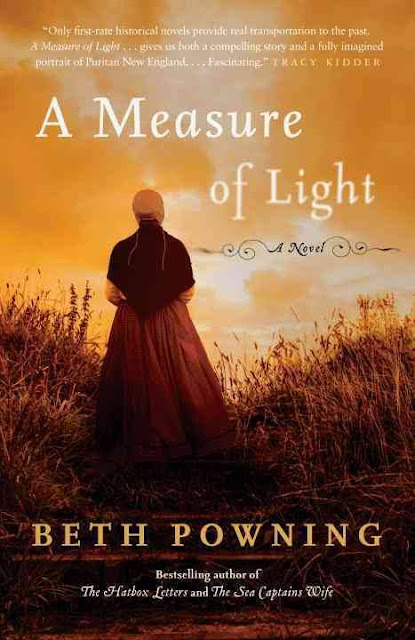
A couple of weeks ago, a new novel mentioned on Facebook piqued my interest. I ordered it almost immediately. A Measure of Light, by bestselling Canadian author Beth Powning, retells the story of Mary Dyer, an English woman who came to Massachusetts as a persecuted Puritan, yet later became one of the earliest American Quakers. 

My mind always seeks connections between what I read and my own life and family, and this was an immediate grab for me. One of my ancestors, Margaret Stevenson Scott, was the last and oldest person hanged by the Puritans in the Salem witch trials. And I also knew that some of my other ancestors were New England Quakers in the 1600 and 1700's. This is not just a historical and genealogical interest for me, either. There is so much in my own life story which resonates with the contrast of Puritans and Quakers.

I'm not sure I was prepared for how this book affected me. And I certainly wasn't prepared for what I found out just after I read it; I was shocked to my core. I'll save that juicy part of the story for the end of this post. (No fair peeking!)

I already knew of the tragic conflicts between Puritans and Quakers from teaching American history to my own children and my home school co-op students for many years. In particular, I love the novel The Witch of Blackbird Pond by Elizabeth George Speare. Yet that was a book for children. An adult level novel like A Measure of Light can fully explore more complexities and nuances, as well as more mature subject matter. Clue: this is not a romance novel.

As the story opens, Mary and her husband William are gravely concerned about the cruel way that the Church of England was treating Puritans. Encouraged by their friend Anne Hutchinson and her husband Will, they decide to flee to America for safety and freedom of worship. On arriving, though, Mary realizes that the Puritans are just as harsh in their punishments against those who dissent from what they believe is the true faith. A culture of strict legalism, fear of divine retribution, demonization of others outside the community (especially native Americans), and tight religious/political control rules the colony. There is little sense of God's loving grace and gospel liberty. Anne helps Mary navigate through the difficulties of adjusting to the community and to motherhood. As a loyal disciple of the Reverend John Cotton, Anne has been entrusted with elucidating his sermons in her home meetings to make the theological meanings clear to the other women. As time passes, Anne puts more emphasis on grace and liberty in her lectures, and men begin attending. All of this ultimately brings her into sharp opposition with Cotton and the other Puritan leaders. She is banished from the colony, and her followers, including the Dyers, move south to Rhode Island. Later, Mary Dyer returns to England for several years and becomes a devout Quaker, passionate about sharing the measure of light she has received with other seeking souls. She is also determined to take a stand for religious liberty for the Quakers in America, and repeatedly risks her own life to plead the cause of those who have been imprisoned and sentenced to death. 

I thought long about her conversion. It is true that the Quakers were not the most orthodox in their theology, particularly in the area of salvation and atonement. However, there is so much to admire. They believe in equality and mutual respect between men and women, between races and nationalities, and between varying socio-economic levels. They believe in peace and simplicity and quietness and supportive communities. They believe in social justice and were key figures in the Underground Railroad. They seek the guidance of the Holy Spirit and an authentic relationship with God. 

I look at the Puritans, who perhaps technically had a more "correct" theological underpinning, but whose application was at times so appalling and soul-shriveling that it negated any benefit. History does not usually look kindly upon them, except for the Pilgrims and Thanksgiving. Then I look at the Quakers, who were a bit loose in their doctrine, but whose application of their FAITH brought life and health and joy to them, as well as empowerment and justice to others.

This is a clear contrast in the book. We cannot know everything of Mary Dyer's true history, but the novel imagines her depression and anxiety, her disconnection from the God she once knew, the difficulties faced in bonding with her children when she has been warned of undue attachments, and her devastation at giving birth to a deformed stillborn baby and then hearing her religious leaders claim this was God's wrath against her. As a Quaker, she is still a very complex woman with deep wounds and a dysfunctional family, at least in the novel version. This is not a happy ever after tale. She has suffered so much spiritually and emotionally, and that leaves a deep imprint on the soul. Yet I rejoiced when she found her "measure of light" and regained a well-seasoned faith, hope, joy, and peace in the midst of the unrelenting challenges she faced. Mary Dyer was hanged in June 1660 after courageously returning to Boston (from which she had been banished) to demand a change to the bloody laws against Quakers. However, as news of this and other executions traveled throughout the colonies and to England, the Puritan leaders were ultimately forced to stop persecuting the Quakers. Unfortunately, that still didn't prevent the Salem Witch Trials. My ancestor, poor old Margaret Scott, an impoverished cranky widow falsely accused of witchcraft, was hanged in September 1692.

But jumping back to my own book reading experience... I started weeping fairly early on, even in the initial descriptions of the colony. This hit way too close to home for me. For many years, we were members of Sovereign Grace Ministries, a church movement heavily influenced by neo-Puritan thought. At the start, I was quite enthusiastic about this. We were the spiritual elite. We could handle the rigorous theology and the expectations for our lifestyle. It was a small price to pay for being so right, eh? Over time, though, my spirit withered under the culture of legalism, control, fear, and a strong emphasis on purging sin from our souls under the watchful guidance of our leaders, whom we were admonished to obey. They also expressed a strong disdain for professional counseling. I held it together the best I could, but I felt like I was under scrutiny. I could never be good enough. I am more of a free spirit, a fluid poet soul. And as a woman, I had little voice, at least when it came to anything of importance outside of my domestic sphere of home schooling and homemaking. We were to live in quietness and deference to men. 

In 2008, I stumbled on two SGM protest blogs, and my tidy yet tenuous little church life really started to unravel. I learned about the devastating effect that the heavy theology and abuse of pastoral and family authority had on members, especially the women and youth. Depression. Anxiety. Morbid introspection. Teen rebellion. Substance abuse. Suicide. Child abuse. Domestic violence. Yikes. That wasn't all. SGM has been embroiled in child molestation scandals for decades, unbeknownst to most members until the accumulated Internet reports hit like a bomb. Families were ordered to not report these crimes to the police; they were to be handled in the church and hushed up. I was disgusted. 

Here is just one example of my experience there toward the end: When I tried to speak up for living by grace in a Bible study meeting, I was openly shamed and ridiculed by a fellow member and nobody would come to my defense. He said he was going to park his (metaphorical) bus over my ideas and back up three times. Grace is for weak little pansies. He insisted that the Christian life is all about violently mortifying our sin. I was then castigated by someone else for daring to correct this man privately for his unacceptable behavior. Because I was a woman, I was supposed to suck it up in silence and accept his superior wisdom. (Here's the irony: This man is different now. He listened and he apologized. Seriously.) I can think of several other times I was chided or silenced in that church for encouraging others to live in authentic grace or for speaking up about abuse of authority. 

By 2010, I'd had enough. My eyes were opened to the deep damage done to my own family, especially my children. It is still hard to shake the sobering knowledge that I allowed this, and that it still profoundly affects them. I found a good grace-filled Christian therapist who patiently walked me through the issues. We left the church that July, along with hundreds of other members of our congregation. I wrote this poem as we were leaving: It Became to Me a Dark Thing. The church eventually parted company with SGM, as did dozens of others. SGM hasn't improved any, and they've come under scathing public criticism, protests at the 2016 T4G conference, and lawsuits. Despite all of this, I do have countless happy memories from this church, too, and many beloved friends there. So many kind and generous and creative people. We've all learned so much. I've had great conversations with the pastors since we left, and I appreciate their sensitivity to my concerns. So there's that. 

I am now a member of a small Presbyterian (PCA) congregation that doesn't get hyped about neo-Calvinism, thank you Jesus. I am still recovering, but at least I found a safe place to land and heal. I am also still seeing a professional therapist.

Like Mary Dyer, in this long process of waking up and moving on, I finally lost my fear and found my true voice. I am a woman, and I am empowered to speak the truth in love. I am a woman, and I can live by the power of the Holy Spirit. I am a woman, and I can be an advocate for the vulnerable among us. I am a woman and a Mama Bear. I wrote so many blog posts on abuse of authority in churches, families, and the home school movement that I eventually started this Watch the Shepherd niche blog for them. It now has 160 posts with over 160,000 page views. 

Yet, like Mary Dyer, I too have suffered much in my soul. I can write around the tattered edges of my own story, but the darker parts are etched deep within my consciousness. While healing comes as a measure of light year by year, the scars cannot be fully undone this side of eternity. I weep as I write.

And I am shaking again as I write this last part, the part about what I learned after I set down the book. I thought of my second cousin Ellen, and briefly posted on her Facebook wall that I thought she'd like the book. Based on what she posts, she has a Quakerish soul, I think. Then as an afterthought, I told her that we have common Quaker heritage and sent her a link to a blog post (The Quakers Up My Family Tree) that I wrote two years ago. Thinking of that old post made me curious, wondering if there were any connections between Mary Dyer and my Quaker ancestors. I read the list of names and saw the English immigrant Noel Mew and his daughter Mary. (Side note: The name Mary was handed down this family line every two or three generations from Mary Mew in the 1600's until my own daughter Mary.) Anyway, I Googled "Mary Dyer" and "Noel Mew" together and came up with a genealogy post for the descendents of a man named Edward Wanton. I was fascinated to find that he was an officer stationed at the base of the gallows where Mary Dyer was hanged. Edward Wanton was so struck and convicted by Mary's faith and courage and by the cruelty of the Puritans -- that he became a Quaker himself. Wow. That is powerful. 


Edward Wanton

But that is not all. After his conversion, Edward Wanton got married, became a Quaker preacher, and had a Quaker family of his own. Two of his sons became colonial governors in Rhode Island. And then how about this? His son Michael married Mary Mew! Thus Edward Wanton is my great-great-great-great-great-great-great-great-great grandfather. I let that sink in and realized that if he hadn't become a Quaker because of standing at the gallows of courageous Mary Dyer, I would not be here. This ripple effect has washed over me like a tidal wave. What she did became my story. I am here because of her. And I am changed by reading her example. I am so grateful. In turn, what I do and what I say becomes the story of others. 

I look at my computer clock here in 2016. Midnight on the dot. It is now Mother's Day.

I am a woman. I am a mother and a grandmother. I have a voice and I'm not afraid to use it. This has already made a difference to many. By the grace and power of God, my life and words will ripple forth and change history. Join me?

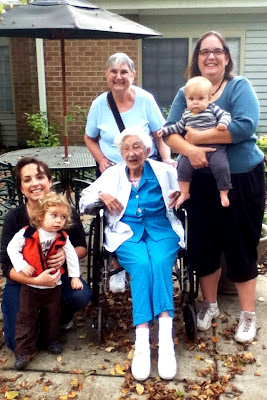
2012: My daughter Mary and her two
oldest sons, my late mother Mary,
my late grandmother Dorothy, and me.

Related blog posts:

Poems:
Essays:

Tuesday, May 20, 2014

"Be Still, My Soul" (Strength in Hymn)


"Be Still, My Soul"
by Katharina von Schlegel, 1697-?

Translated by Jane Borthwick, 1813-1897


Be still, my soul; the Lord is on thy side;
Bear patiently the cross of grief or pain;
Leave to thy God to order and provide;
In every change He faithful will remain.
Be still, my soul; thy best, thy heavenly, Friend
Through thorny ways leads to a joyful end.


Be still, my soul; thy God doth undertake
To guide the future as He has the past.
Thy hope, thy confidence, let nothing shake;
All now mysterious shall be bright at last.
Be still, my soul; the waves and winds still know
His voice who ruled them while He dwelt below.

 
Be still, my soul, though dearest friends depart
And all is darkened in the vale of tears;
Then shalt thou better know His love, His heart,
Who comes to soothe thy sorrows and thy fears.
Be still, my soul; thy Jesus can repay
From His own fulness all He takes away.

 
Be still, my soul; the hour is hastening on
When we shall be forever with the Lord,
When disappointment, grief, and fear are gone,
Sorrow forgot, love's purest joys restored.
Be still, my soul; when change and tears are past,
All safe and blessed we shall meet at last.


Listen here: Libera Boys Choir

Why I Picked This Hymn
(And Thoughts Disillusionment, and Passivity vs. Assertiveness)

       While my daughter Julia was in labor last Friday with her sweet little guy, I stopped at the Christian bookstore down the street and browsed the bargain rack for a book to read in the waiting room.  I found Angry Conversations with God: A Snarky but Authentic Spiritual Memoir by actress, comedienne, and screenwriter Susan E. Isaacs.  I bought it, knowing that it would fit right in with some of the themes of this blog like faith crisis and spiritual disillusionment.  I managed to polish it off pretty quickly.   She writes raw, somewhat akin to Anne Lamottbut not quite as "out there."  Particularly sensitive readers may not appreciate her candor or her language.   There is so much that the author experienced that I haven’t, such as prolonged singleness, alcoholism, eating disorders, and sexual promiscuity. However, there is so much I could directly relate to, like diverse church & friendship experiences,  recovering  from spiritual/emotional abuse, being angry at God (yes, me too, sometimes), or the frustrations of being a more fluid, poetic, creative, ADD thinker among those who tend to be more linear and boxy.  She quotes this first verse of the hymn near the end of the book, writing: 

“I dragged myself to church that Sunday.  I had to show up now and then since I worked at the church office.  The worship band played their usual 7/11 songs (seven words repeated eleven times). People raised their hands in bliss or triumph.  What did they feel that I didn’t?  What did they know that I didn’t?  I sat down in protest.  And then some guy walked up to the piano and started playing “Finlandia,” one of the most beautiful pieces of music ever written.  A singer came forward and sang, “Be Still My Soul,” a hymn I’d known since childhood.”


       Ms. Isaacs offers no other commentary about the hymn right then, but from reading the book, I sense that it was an anchor to her soul, or perhaps a life vest thrown forward from her Lutheran upbringing.  A beautiful hymn like this speaks to the heart, whether it is in a lush and haunting melody, or the deep words of comfort and hope amidst so much that is either crushing or trite or, worse yet, both.   

       In this hymn, it seems that most of the promise comes in the afterlife, when "All now mysterious shall be bright at last" and "When we shall be forever with the Lord, when disappointment, grief, and fear are gone."   This hymn seems to advocate passivity in suffering.  There is truth in her words, "Bear patiently the cross of grief or pain; leave to thy God to order and provide," when we are in situations beyond our control, where there is nothing to do but wait and trust.  However, that does not mean we sit by and do nothing if we can, in fact, do something.  Sometimes that "something" starts with asking others for help in our own sorry situations, or raising awareness about the sufferings or others.  Then we go forward from there.  We should never advocate passivity when it is used to further victimize the oppressed by keeping them under silent bondage.  That is essentially saying, "Gut it up, it will all be OK in heaven.  Until then, just shut up and submit to what you're given."   God forbid!  There are plenty of times to stand up and declare, "Enough!"  -- and then take real assertive action to stop the injustice, whether it is for yourself, your children, your friends, your local community, or even strangers halfway around the globe in Nigeria.   

       Where does the "be still my soul" come in then?  It comes in our foundation of trust in God, who cares for us and empowers us as we dare to do right.  I can do this (whatever "this" is) because, no matter what happens, God is with me and he can guide me as I pay attention.  Even if  I lose my life or my lifestyle trying to bring truth, justice, and compassion in a dark world, this is not the end.  There is still more for me in eternity, and it is bright.

The Story Behind the Hymn
       Katharina von Schlegel belonged to a Lutheran religious order in the 18th century.  You can read more about her at these sites and others:


       Finnish composer Jean Sibelius wrote “Finlandia” as a protest anthem against Czarist Russia.   Only a small section of this symphonic poem is used in the hymns  “Be Still, My Soul” and “We Rest on Thee” and several others.  It was also used as the tune of the national anthem of the short-lived African country of Biafra.

     This hymn is the 36th in my Strength in Hymn series.

Grace and peace,
Virginia Knowles


P.S. I took these photos in Baldwin Park, Florida, in a little plaza with a fountain, while we waited for my teens to get out of youth group, and just after this little Melody girl had helped serve at a monthly dinner that her big sister Julia organizes for our homeless friends.   Redemption action starts young.

I often link my posts to these blogs:


  • Still Saturday
  • The Sunday Community


  •   

    Monday, April 21, 2014

    On Patriarchy, Scandal, Abuse... and Grace

    My 10 children and two not-picture-happy grandsons
    (and two more grandsons yet to be born)
    in an impromptu family photo on Easter 2014
    Dear friends,

    My heart is very weary these days reading stories about scandal in churches, religious organizations, and families. So much going on, and nothing really surprises me anymore. For years, I have been researching abuse of spiritual authority. On the one hand, I am glad that darkness is being brought to light and families are being released from bondage of many sorts. Still, I am saddened to hear of all who have been so wounded by errant religious leaders who preached what they did not practice. 

    So many of my loved ones have been hurt, especially by the patriarchy movement that has been popular among large home schooling families like mine. This hits way too close to home. I also get lot of e-mails from people who read my blogs, and I can tell you, the damage is deep and wide. I grieve.

    My angst is not just about the allegations of sexual misconduct. It is about legalistic and hypocritical teaching that has destroyed families.  It's not just Doug Phillips, but men like Bill Gothard, Doug Wilson, C.J. Mahaney, and Mark Driscoll. I greatly respected them, even put them on pedestals. I regret that now. I sincerely apologize to any of you who started following their teaching because of anything I wrote. At the bottom of this post, there is a whole slew of links for you on some of the problems caused by patriarchal leaders and organizations. This is just a fraction of what is out there.

    I love Jesus. I love people. This is not about gossiping or being bitter or judgmental. It is about setting people free and helping them move toward wholeness. I hate authoritarian abuse. I hate religious legalism. I hate the hypocrisy of those who vehemently preach one thing and flagrantly practice the opposite. Yet I was part of this, to a certain extent, even if mainly by association. I am a mother of 10 who became an eager participant in the full quiver / home education movement over 25 years ago after reading Mary Pride's books. This was my life. I read about it, tried to live it, promoted it. I love my 10 kids. I love home schooling. That is not the problem. It's how I did it because of who I allowed to influence me.  I am so sorry for the damage that my own children suffered because of this. I am so grateful, by the grace of God, that we are all still very close, and that everyone is somehow pulling through in their own ways. I've heard some of them say, "We're not doing everything quite the way you did," and I, with relief, say, "That's a very good thing!"

    We still have a long way to go. I woke on Easter morning with so much on my mind, so many struggles and failures and unmet expectations. On top of my troubled thoughts, I hadn't slept well and I still had so much to do before family came over in the afternoon. I usually fix a decent Easter breakfast with eggs and such, but yesterday, I was so overwhelmed that I just didn't.  I was all "pickles and prickles" as we got ready for church. In the van, I realized that none of my five younger children had even taken the time to grab a bowl of cereal. (Oh, bad Mommy! Wait. Not! That one's on them, and they didn't even care about it! It's a good thing our church sets out granola bars...) Such a small thing among the bigger ones.  

    In the midst of my Easter fluster, I appreciated my pastor reminding us that we still live in a fallen "Good Friday" world, and that we need the resurrection story every day. I know I do! I was also glad to hear him affirm how much Jesus did to overthrow patriarchal attitudes toward women by welcoming them into his ministry and opposing those who tried to oppress them. When he rose from the dead, he called Mary Magdalene by name and sent her out as the first witness of his resurrection in a culture which did not even allow the testimony of a woman in court. Jesus valued women. He values me. He values you, whether you are male or female, old or young, rich or poor, weak or strong... 

    Please, dear sisters and brothers, if you are reading this, wherever you are, whatever has happened or is happening in your life, please find your grace and liberty and healing. There may be some things that you need to let go and other things you need to embrace. It is sometimes crazy scary, but it will be worth it.

    If you like what you see in this post, considering subscribing to this blog using subscribe options in the sidebar.

    Finally, here are some general links from my blogs, and then some about Doug Phillips and Bill Gothard on other sites.

    On my blogs:


    Other blogs and news sites...