Showing posts with label Grace. Show all posts

Sunday, July 7, 2019

Open a Door


Devote yourselves to prayer, 
being watchful and thankful.
And pray for us, too, that
God may open a door 
for our message
so that we may proclaim 
the mystery of Christ, 
for which I am in chains. 
Pray that I may proclaim it 
clearly, as I should. 
Be wise in the way you act 
toward outsiders; 
make the most 
of every opportunity. 
Let your conversation be 
always full of grace, 
seasoned with salt, 
so that you may know 
how to answer everyone.


~*~*~

I am taking the Vocation of Ministry class online this summer from Asbury Seminary. We are reading Sacred Rhythms: Arranging Our Lives for Spiritual Transformation by Ruth Haley Barton as an encouragement to embrace the spiritual disciplines such as solitude, prayer, and Scripture. I have practiced Lectio Divina as an approach to Scripture study before. It is a slow, reflective reading of a short passage, seeking to hear from God, meditate on the words, pray the Scripture, and find ways to apply it. The goal is transformation rather than information. 

Barton also recommends listening for one word or phrase that stands out, one that God is bringing to mind right now. That is not my usual practice, but as I sat tonight with Colossians 4:2-6, I pondered it phrase by phrase, line by line. What resonated most with me? 

"Open a door..."

Why this phrase? I realize that in the strictest interpretive context, this is about evangelism. Paul is talking about God opening doors in the community and the world for people to hear and receive the gospel for the first time. 

However, what resonates with me, and is also true, is that God wants my own heart to be open to the word, too. Aren't there so many ways we close ourselves off to God? Even as a believer for 43 years, I know I do. Whether it is from apathy, or resistance, or fearful self-protection, I close myself off to what I need most: a fresh message from God, Scripture for my own soul. What is the remedy? That is here too: devotedly, prayerfully, watchfully, thankfully contemplating the mystery of God's message of grace and letting it do its deep work inside of me. I need God to open that door... in me!

And you know what? This is still about sharing the gospel with others.

When they see me embracing God's word, taking it seriously, letting it shape me, that speaks powerfully into their souls. When they hear gracious words, salted with divine wisdom, that's redemption on display. When I make the most of my time for the Kingdom, choosing my actions with intention, that's such a witness to the goodness of God. This is one way God opens the door in their lives: by seeing the open door in ours.

You know, God actually already said this through Colossians 3:16-17. The message dwelling within, the overflowing gratitude, the wise words and the deeds that please the Lord... It's all there.

Let the message of Christ 
dwell 
among you richly 
as you teach and admonish 
one another with all wisdom 
through psalms, hymns, 
and songs from the Spirit, 
singing to God with 
gratitude in your hearts. 
And whatever you do, 
whether in word or deed
do it all in the name 
of the Lord Jesus, 
giving thanks 
to God the Father 
through him.


The word of the Lord.
Thanks be to God.
Hallelujah!
Open the door!

Grace and peace,
Virginia Knowles

P.S. Related posts on Scripture and seminary:

Plus, one from another site, also an Asbury assignment:

Saturday, April 13, 2019

The Goal is Not Control, But Empowerment


"Has the community served to make individuals free, strong, and mature, or has it made them insecure and dependent? Has it taken them by the hand for a while so that they would learn again to walk by themselves, or has it made them anxious and unsure? This is one of the toughest and most serious questions that can be put to any form of everyday Christian life in community." Dietrich Bonhoeffer, Life Together

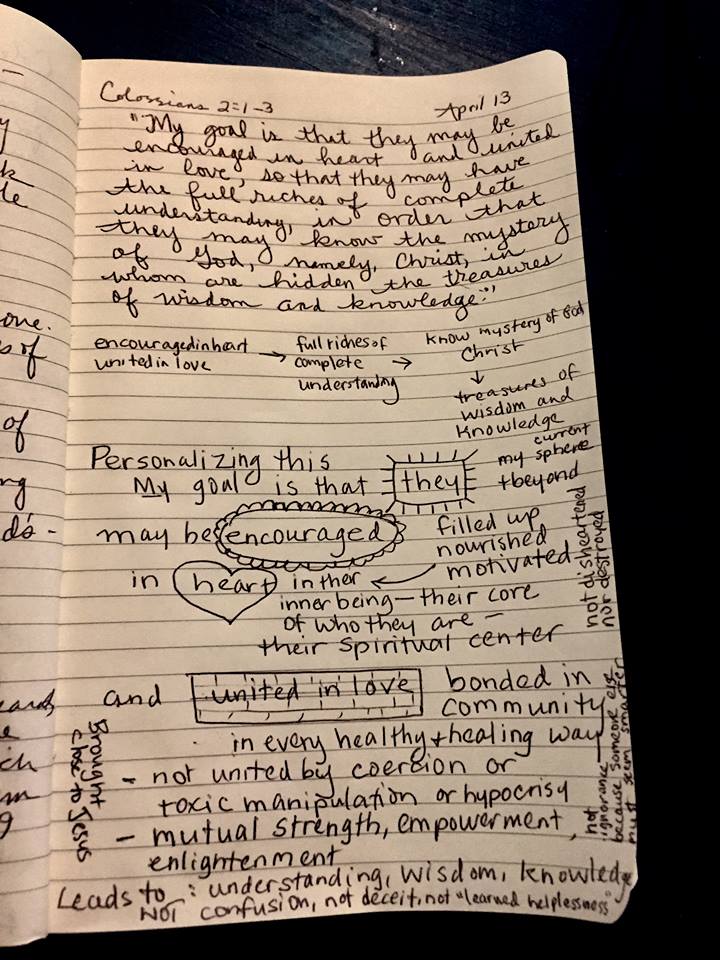
I just read Bonhoeffer's book Life Together as a Church History assignment last week, and I love how this quote coincides with my own personal Scripture study. I'm working through Colossians right now, taking notes in my journal. This isn't a formal study of a passage, as I would do for my seminary classes. It's more of the Read + Reflect + Respond approach that I've used for about 40 years. I sometimes cover only a very short section each day. 

Today I pondered Colossians 2:2-3.

My goal is that they may be encouraged in heart and united in love, so that they may have the full riches of complete understanding, in order that they may know the mystery of God, namely, Christ, in whom are hidden all the treasures of wisdom and knowledge.

This is the apostle Paul describing his strenuous and sacrificial labors as a single man traveling in the ancient world, preaching the gospel, establishing churches, and writing letters of instruction and encouragement that we still read today. 

Here is what struck me as I sought to make application to my own life and ministry as a home school mom, grandma, seminary student, crisis hotline worker, friend, and social media user. What is the best way to help people grow in life? How will they be affected by my influence? How have I been affected by the influence of others on my spiritual life?

Many of the people in my own circle, both those I've met personally and my connections on social media, have experienced a significant amount of spiritual / emotional / physical abuse in the context of the church / family / organization. They are understandably wary of any kind of God-talk because religion has been used to control and coerce them. But that is not what God has in mind!


Read the verses again with me as I offer a little informal commentary along the way...

My goal is that they may be encouraged in heart...

  • Goal: purpose, motivation, desired result
  • Encouraged: filled up, nourished, flourishing, refreshed, motivated, empowered, strengthened
  • Heart: inner being, spiritual center, core of who they are as an individual

Two questions: Is this your goal as you influence others? Is this the goal of those who are influencing you? An abuser or dysfunctional dominant leader may claim they want to lead others in the righteous ways of God, but what is the fruit? Are those in their "care" being filled up or drained out, nourished or famished, flourishing or withering, refreshed or parched, liberated or enslaved, healed or wounded, motivated or demoralized, empowered or hindered, strengthened or weakened?

...and united in love...

I see "united in love" as a healthy and healing bond. There is mutual strength, a synergy (working better together than apart) that enables greater fruitfulness. This is not a suffocating or constricting relationship. Some people think that an abusive relationship is disconnected, and in one sense it is because there is no sense of mutual partnership. However, there is a toxic bondage that throws others aside like trash but won't let them leave. Things may improve for a while, just enough to give hope that things will change. But then it escalates again, over and over. That's called the cycle of abuse, and it's why people stay instead of escaping! It's a "unity of control" but only unity in the sense that there is one person setting the agenda. That's not even true unity. It is just unilateral. 

But Colossians 2:2-3 offers a powerful contrast: wholesome bonding, being truly united in LOVE. Don't accept a counterfeit to that.

...so that they may have the full riches of complete understanding, in order that they may know the mystery of God, namely Christ, in whom are hidden the treasures of wisdom and understanding.

So being encouraged in heart and united in love is a means to further goal, which is knowing and experiencing the abundance of a spiritual life in Jesus Christ. This is a growth and enlightenment process that starts in the heart, that core of who you are. It's walking with Jesus through grace and faith, leaning into who he is and what he wants. It's not a system of pointless rules, or of conforming to the selfish expectations of others. It's an authentic transformation. An abuser communicates, "All you need to know is what I tell you." Abusers want to control the narrative. If others are under their "leadership" they don't want them to explore the Bible for themselves, seek out more education that might contradict what they are being told, have their own opinions, know enough to contradict them or hold them accountable, or be emotionally strong enough to challenge or leave them. They paralyze others through confusion, deceit, accusations, threats, trauma bonding, and religious manipulation. They communicate either overtly (in direct words) or covertly (by implication): "You are being rebellious. Rebellion is as the sin of witchcraft. I am your God-given leader. God wants you to obey me. You will never succeed unless you listen to me. God will punish you. I just want what's best for you. You are sowing discord. You are just bitter. You never want to be accountable to anyone. You are usurping my authority. You are out of line. Why don't you just let me lead? Look at me! I'm the important one here!" 

To a lesser extent, this dynamic of control can also occur inadvertently with leaders who aren't even trying to be selfish. They may think that  demanding compliance to their commands is what they are supposed to be doing as bold leaders, but this still leads to disillusioned, disempowered followers. I have often found myself slipping into this dynamic as a mother, usually as an overflow of the emotions of fear and shame. ("If I don't make them obey, I'll be a failure as a mother.")

I encourage you to evaluate your own family, friendships, churches, organizations and other your spiritually-based relationships, no matter which role you play. Does this relationship or community display the riches of God? Is this true wisdom that leads to abundant spiritual understanding? Are we growing together in our core relationships with Jesus and one another? Are we seeing Jesus as both the source and goal? Is this a treasure or a theft?

My goal is to be spiritually empowered so that I can empower others. I don't want to control or be controlled. I want to have a full life in Jesus Christ and inspire others to do the same. How about you?

Grace and peace,
Virginia

P.S. Lots of links to extend these thoughts!

Sunday, May 8, 2016

The Puritans, The Quakers, and Little Old Me (Reflections on A Measure of Light)


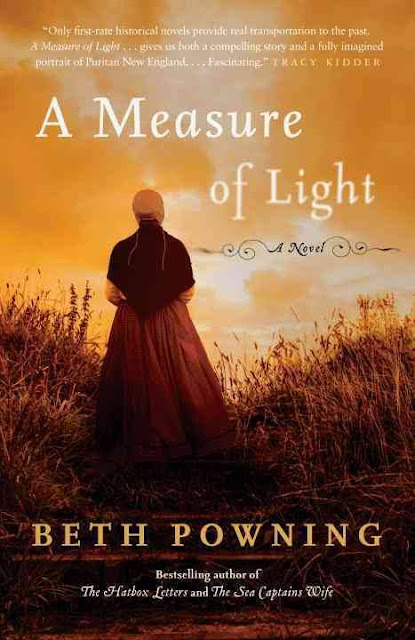
A couple of weeks ago, a new novel mentioned on Facebook piqued my interest. I ordered it almost immediately. A Measure of Light, by bestselling Canadian author Beth Powning, retells the story of Mary Dyer, an English woman who came to Massachusetts as a persecuted Puritan, yet later became one of the earliest American Quakers. 

My mind always seeks connections between what I read and my own life and family, and this was an immediate grab for me. One of my ancestors, Margaret Stevenson Scott, was the last and oldest person hanged by the Puritans in the Salem witch trials. And I also knew that some of my other ancestors were New England Quakers in the 1600 and 1700's. This is not just a historical and genealogical interest for me, either. There is so much in my own life story which resonates with the contrast of Puritans and Quakers.

I'm not sure I was prepared for how this book affected me. And I certainly wasn't prepared for what I found out just after I read it; I was shocked to my core. I'll save that juicy part of the story for the end of this post. (No fair peeking!)

I already knew of the tragic conflicts between Puritans and Quakers from teaching American history to my own children and my home school co-op students for many years. In particular, I love the novel The Witch of Blackbird Pond by Elizabeth George Speare. Yet that was a book for children. An adult level novel like A Measure of Light can fully explore more complexities and nuances, as well as more mature subject matter. Clue: this is not a romance novel.

As the story opens, Mary and her husband William are gravely concerned about the cruel way that the Church of England was treating Puritans. Encouraged by their friend Anne Hutchinson and her husband Will, they decide to flee to America for safety and freedom of worship. On arriving, though, Mary realizes that the Puritans are just as harsh in their punishments against those who dissent from what they believe is the true faith. A culture of strict legalism, fear of divine retribution, demonization of others outside the community (especially native Americans), and tight religious/political control rules the colony. There is little sense of God's loving grace and gospel liberty. Anne helps Mary navigate through the difficulties of adjusting to the community and to motherhood. As a loyal disciple of the Reverend John Cotton, Anne has been entrusted with elucidating his sermons in her home meetings to make the theological meanings clear to the other women. As time passes, Anne puts more emphasis on grace and liberty in her lectures, and men begin attending. All of this ultimately brings her into sharp opposition with Cotton and the other Puritan leaders. She is banished from the colony, and her followers, including the Dyers, move south to Rhode Island. Later, Mary Dyer returns to England for several years and becomes a devout Quaker, passionate about sharing the measure of light she has received with other seeking souls. She is also determined to take a stand for religious liberty for the Quakers in America, and repeatedly risks her own life to plead the cause of those who have been imprisoned and sentenced to death. 

I thought long about her conversion. It is true that the Quakers were not the most orthodox in their theology, particularly in the area of salvation and atonement. However, there is so much to admire. They believe in equality and mutual respect between men and women, between races and nationalities, and between varying socio-economic levels. They believe in peace and simplicity and quietness and supportive communities. They believe in social justice and were key figures in the Underground Railroad. They seek the guidance of the Holy Spirit and an authentic relationship with God. 

I look at the Puritans, who perhaps technically had a more "correct" theological underpinning, but whose application was at times so appalling and soul-shriveling that it negated any benefit. History does not usually look kindly upon them, except for the Pilgrims and Thanksgiving. Then I look at the Quakers, who were a bit loose in their doctrine, but whose application of their FAITH brought life and health and joy to them, as well as empowerment and justice to others.

This is a clear contrast in the book. We cannot know everything of Mary Dyer's true history, but the novel imagines her depression and anxiety, her disconnection from the God she once knew, the difficulties faced in bonding with her children when she has been warned of undue attachments, and her devastation at giving birth to a deformed stillborn baby and then hearing her religious leaders claim this was God's wrath against her. As a Quaker, she is still a very complex woman with deep wounds and a dysfunctional family, at least in the novel version. This is not a happy ever after tale. She has suffered so much spiritually and emotionally, and that leaves a deep imprint on the soul. Yet I rejoiced when she found her "measure of light" and regained a well-seasoned faith, hope, joy, and peace in the midst of the unrelenting challenges she faced. Mary Dyer was hanged in June 1660 after courageously returning to Boston (from which she had been banished) to demand a change to the bloody laws against Quakers. However, as news of this and other executions traveled throughout the colonies and to England, the Puritan leaders were ultimately forced to stop persecuting the Quakers. Unfortunately, that still didn't prevent the Salem Witch Trials. My ancestor, poor old Margaret Scott, an impoverished cranky widow falsely accused of witchcraft, was hanged in September 1692.

But jumping back to my own book reading experience... I started weeping fairly early on, even in the initial descriptions of the colony. This hit way too close to home for me. For many years, we were members of Sovereign Grace Ministries, a church movement heavily influenced by neo-Puritan thought. At the start, I was quite enthusiastic about this. We were the spiritual elite. We could handle the rigorous theology and the expectations for our lifestyle. It was a small price to pay for being so right, eh? Over time, though, my spirit withered under the culture of legalism, control, fear, and a strong emphasis on purging sin from our souls under the watchful guidance of our leaders, whom we were admonished to obey. They also expressed a strong disdain for professional counseling. I held it together the best I could, but I felt like I was under scrutiny. I could never be good enough. I am more of a free spirit, a fluid poet soul. And as a woman, I had little voice, at least when it came to anything of importance outside of my domestic sphere of home schooling and homemaking. We were to live in quietness and deference to men. 

In 2008, I stumbled on two SGM protest blogs, and my tidy yet tenuous little church life really started to unravel. I learned about the devastating effect that the heavy theology and abuse of pastoral and family authority had on members, especially the women and youth. Depression. Anxiety. Morbid introspection. Teen rebellion. Substance abuse. Suicide. Child abuse. Domestic violence. Yikes. That wasn't all. SGM has been embroiled in child molestation scandals for decades, unbeknownst to most members until the accumulated Internet reports hit like a bomb. Families were ordered to not report these crimes to the police; they were to be handled in the church and hushed up. I was disgusted. 

Here is just one example of my experience there toward the end: When I tried to speak up for living by grace in a Bible study meeting, I was openly shamed and ridiculed by a fellow member and nobody would come to my defense. He said he was going to park his (metaphorical) bus over my ideas and back up three times. Grace is for weak little pansies. He insisted that the Christian life is all about violently mortifying our sin. I was then castigated by someone else for daring to correct this man privately for his unacceptable behavior. Because I was a woman, I was supposed to suck it up in silence and accept his superior wisdom. (Here's the irony: This man is different now. He listened and he apologized. Seriously.) I can think of several other times I was chided or silenced in that church for encouraging others to live in authentic grace or for speaking up about abuse of authority. 

By 2010, I'd had enough. My eyes were opened to the deep damage done to my own family, especially my children. It is still hard to shake the sobering knowledge that I allowed this, and that it still profoundly affects them. I found a good grace-filled Christian therapist who patiently walked me through the issues. We left the church that July, along with hundreds of other members of our congregation. I wrote this poem as we were leaving: It Became to Me a Dark Thing. The church eventually parted company with SGM, as did dozens of others. SGM hasn't improved any, and they've come under scathing public criticism, protests at the 2016 T4G conference, and lawsuits. Despite all of this, I do have countless happy memories from this church, too, and many beloved friends there. So many kind and generous and creative people. We've all learned so much. I've had great conversations with the pastors since we left, and I appreciate their sensitivity to my concerns. So there's that. 

I am now a member of a small Presbyterian (PCA) congregation that doesn't get hyped about neo-Calvinism, thank you Jesus. I am still recovering, but at least I found a safe place to land and heal. I am also still seeing a professional therapist.

Like Mary Dyer, in this long process of waking up and moving on, I finally lost my fear and found my true voice. I am a woman, and I am empowered to speak the truth in love. I am a woman, and I can live by the power of the Holy Spirit. I am a woman, and I can be an advocate for the vulnerable among us. I am a woman and a Mama Bear. I wrote so many blog posts on abuse of authority in churches, families, and the home school movement that I eventually started this Watch the Shepherd niche blog for them. It now has 160 posts with over 160,000 page views. 

Yet, like Mary Dyer, I too have suffered much in my soul. I can write around the tattered edges of my own story, but the darker parts are etched deep within my consciousness. While healing comes as a measure of light year by year, the scars cannot be fully undone this side of eternity. I weep as I write.

And I am shaking again as I write this last part, the part about what I learned after I set down the book. I thought of my second cousin Ellen, and briefly posted on her Facebook wall that I thought she'd like the book. Based on what she posts, she has a Quakerish soul, I think. Then as an afterthought, I told her that we have common Quaker heritage and sent her a link to a blog post (The Quakers Up My Family Tree) that I wrote two years ago. Thinking of that old post made me curious, wondering if there were any connections between Mary Dyer and my Quaker ancestors. I read the list of names and saw the English immigrant Noel Mew and his daughter Mary. (Side note: The name Mary was handed down this family line every two or three generations from Mary Mew in the 1600's until my own daughter Mary.) Anyway, I Googled "Mary Dyer" and "Noel Mew" together and came up with a genealogy post for the descendents of a man named Edward Wanton. I was fascinated to find that he was an officer stationed at the base of the gallows where Mary Dyer was hanged. Edward Wanton was so struck and convicted by Mary's faith and courage and by the cruelty of the Puritans -- that he became a Quaker himself. Wow. That is powerful. 


Edward Wanton

But that is not all. After his conversion, Edward Wanton got married, became a Quaker preacher, and had a Quaker family of his own. Two of his sons became colonial governors in Rhode Island. And then how about this? His son Michael married Mary Mew! Thus Edward Wanton is my great-great-great-great-great-great-great-great-great grandfather. I let that sink in and realized that if he hadn't become a Quaker because of standing at the gallows of courageous Mary Dyer, I would not be here. This ripple effect has washed over me like a tidal wave. What she did became my story. I am here because of her. And I am changed by reading her example. I am so grateful. In turn, what I do and what I say becomes the story of others. 

I look at my computer clock here in 2016. Midnight on the dot. It is now Mother's Day.

I am a woman. I am a mother and a grandmother. I have a voice and I'm not afraid to use it. This has already made a difference to many. By the grace and power of God, my life and words will ripple forth and change history. Join me?

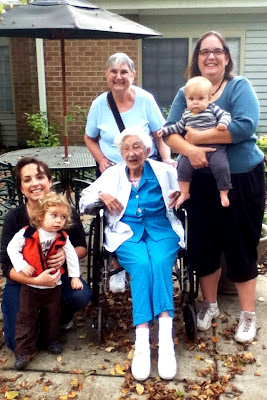
2012: My daughter Mary and her two
oldest sons, my late mother Mary,
my late grandmother Dorothy, and me.

Related blog posts:

Poems:
Essays:

Monday, February 2, 2015

Mara's Story: Anger After Abuse (DV Story #4)


Last year, I featured a three part series of interviews with domestic violence survivors, in hopes of helping abused women find healing and educating others in how to respond with wisdom and compassion. You can find those interviews here:
Now “Mara” has come forward with some thoughts on anger after abuse. This is not technically an interview since it is not in Q & A format, and at her request I have also done substantial organizational and style editing to best convey her thoughts, so I guess you could say this is a collaborative guest post of sorts. No matter what you call it, let's welcome Mara.

~*~*~
Hello!

Like the other women who have shared their stories on this blog, I have chosen a pseudonym to protect my family's privacy. “Mara” is my name for this story because it means bitter. But that's not the end of my story.

Here is how I will start.

I am a survivor of many years of physical aggression and emotional abuse in the home. It hurts to even type those words, but that one sentence cannot even begin to convey the depths of pain this has entailed. It is a “Mara” life.

Where do I get the “Mara” concept?

In Exodus 15:22-25, we read “Then Moses led Israel from the Red Sea and they went into the Desert of Shur. For three days they traveled in the desert without finding water. When they came to Marah, they could not drink its water because it was bitter. (That is why the place is called Marah.) So the people grumbled against Moses, saying, “What are we to drink?” Then Moses cried out to the Lord, and the Lord showed him a piece of wood. He threw it into the water, and the water became fit to drink.” (Some versions say that the bitter water actually became sweet.)

Then in the book of Ruth, an older woman named Naomi has suffered deep loss with a famine, an exile, and the deaths of her husband and two sons. As she returns home to Bethlehem after her long sojourn in Moab, she tells her old friends, "Don't call me Naomi. Call me Mara, because the Almighty has made my life very bitter.” Her spirit has been crushed and she doesn't see much hope for the future. Yet that is not the end of the story. By the end of the book, she has been restored to connection and joy.

I like those two stories. They speak redemption in the end, when all is well again.

Yet it troubles me that when people are trying to relate to a woman who has suffered abuse, they want to paste on a “happily ever after” ending once she is “safely” out of her dangerous situation. Now we can move merrily along, can't we? It's easier that way than actually walking with her step by step on what will be a long and bumpy path. Her pain and anger and even her danger are not nearly over.

It troubles me even more that when an abuse survivor is processing anger that people heap more shame on her. “Forgive and forget!” “Move on!” “Stop being so bitter!” “Everyone makes mistakes! What about your own sin? Take the log out of your eye, will you?”

I am still angry. At a lot of people.

I am angry at the man who mistreated me and my children.That one is obvious. He was supposed to nurture and protect, not use aggression or manipulation to try to control us!

I am angry at myself and even my children for not being good enough to be treated well. If ​we had just been more compliant, more diligent, more organized, more quiet, more sweet, more... Well, maybe we could have been a happy family. Of course we could never be good enough, not in a million years, to please one who can't be pleased. I know that. I really do. But I am still angry at myself for not being more. I am also angry at myself for not realizing what was happening until I was in over my head. Also, for not being a “good enough” mom in the aftermath when everyone was hurting and it was so hard to give grace out of my emptiness. I just accidentally typed that last word as emptimess. Yes, I am an empty mess sometimes.
I am angry at those who failed to protect me or who told me that I had no rights to speak up. I am angry at those who judged me for staying so long in my marriage. I am angry at those who have judged me for leaving. I am angry at those who are completely innocent and clueless, because I am jealous of their ignorance and their perfect untroubled lives. I wish I didn't know what I know.

I am sometimes angry at God, because he did know and it still happened. I could easily echo Naomi's words: “...the Almighty has made my life very bitter.”

By now you must think of me as a total piece of work, a woman who spends her days fuming and foaming at the mouth, shaking her fists at heaven.

I don't.

I get up every day and live my life. I don't think about anger or bitterness most of the time. I forgive offenses as quickly as I can. I try to bless those who have mistreated me. I go to church and read the Bible and pray. I thank God for so many things.

Some people say that anger cannot co-exist with thankfulness. I disagree. I can be angry and thankful at the same time. I can be angry about an injustice – because it is WRONG and should be opposed – and yet still thankful for God's strength and provision for me within it.

Let's try it on my anger list above.

While I am angry that the man I married chose to act abusively, I am thankful that God has enabled me to still appreciate some of his good qualities. It is by the mercy of God that we can co-parent in relative peace now that we no longer live in the same home. He is still conscientious about providing for us and helping us out in many ways. Yes, I am thankful.

While I am angry at myself for not being "good enough" as a wife and mother, I am thankful that I am able to work through these issues with help from a counselor and take steps to make practical changes because they are right, not because they will get me approval. While I am angry about living in denial about the abuse for too long, I am thankful that did finally realize the problems and took action to keep my family safe. My kids know I love them even when we all mess up. I do know how to apologize. So do they. That helps. I am most thankful that I don't have to be good enough for God. He takes me where I am but doesn't leave me there. He is working in my heart and I see growth. That's good enough for me.

While I am angry that some others have not responded with (perfect) wisdom or compassion to my situation, I am thankful for those who have at least tried. I treasure the network of friends and family who have stood by me, encouraged me, and helped me in many practical ways. I am a voice to help others understand, not just my own story, but those of so many others vulnerable women and children. I can give courage to the oppressed, because I have been there, too, and I know what it's like. Yes, I sometimes resent those whose lives are relatively untroubled compared to mine, but I am thankful – really thankful! - that they have their untarnished peace and joy. I won't begrudge them that. Besides, they may in fact be fighting a secret battle I never see. That is a reminder to always be kind to everyone.

And the final one is sobering. While I am sometimes angry at God, I am thankful that he is big enough, strong enough, merciful enough to handle it. The Good Book says, “A bruised reed he will not break.” People will still make their poor choices, but he helps me to be resilient instead of brittle. I am thankful for that.

Oh my, this has turned out to be a really long guest post. I'd better stop now! Thanks for reading this far, and God bless!


Thank you so much, Mara! That was really an encouraging perspective on anger and thankfulness. God bless you, too!

May God bless us all.


Virginia Knowles

Saturday, October 25, 2014

Kyrie Eleison (Strength in Hymn)


"Kyrie Eleison"

Kyrie eleison
Christe eleison
Kyrie eleison


Lord, have mercy
Christ, have mercy
Lord, have mercy


This is the ancient “Jesus Prayer” sung as a hymn in the liturgy of churches around the world. 


When times are stressful, I can’t always concentrate on a long complicated prayer. Jesus hears me whisper this, and he knows what’s in my heart. 


Here is an amazing modern version by Keith and Kristyn Getty, as performed by the Christ Church choir in Nashville. It has additional English verses about justice, compassion, healing, and mercy. 


Note: Pictures were taken at dusk at Kewanee Park in Maitland, Florida. The sunset colors fade fast, so I had to catch them while I could. For more photos of the same park at daytime, see Kewanee Park on a Foggy Day.

Sunday, April 13, 2014

I Know that My Redeemer Lives (Strength in Hymn)


I Know that My Redeemer Lives

By: Samuel Medley (1738-1799)


I know that my Redeemer lives!
What comfort this sweet sentence gives!
He lives, he lives, who once was dead;
He lives, my ever living head!


He lives triumphant from the grave;
He lives eternally to save;
He lives exalted, throned above;
He lives to rule his Church in love.


He lives to grant me rich supply;
He lives to guide me with his eye;
He lives to comfort me when faint;
He lives to hear my soul’s complaint.


He lives to silence all my fears;
He lives to wipe away my tears;
He lives to calm my troubled heart;
He lives all blessings to impart.


He lives to bless me with his love;
He lives to plead for me above;
He lives my hungry soul to feed;
He lives to help in time of need.


He lives, my kind, wise, heavenly friend;
He lives and loves me to the end;
He lives, and while he lives, I’ll sing;
He lives, my Prophet, Priest, and King!


He lives and grants me daily breath;
He lives, and I shall conquer death;
He lives my mansion to prepare;
He lives to bring me safely there.


He lives, all glory to his name!
He lives, my savior, still the same;
What joy this blest assurance gives:
I know that my Redeemer lives!


Today is Palm Sunday,
the start of Holy Week!

May this remembrance
and this obscure old Lutheran Easter hymn
be a blessing to you and your family.

You might like to visit my Holy Week and Easter Link page.