Showing posts with label Stress~Weariness. Show all posts

Saturday, April 13, 2019

The Goal is Not Control, But Empowerment


"Has the community served to make individuals free, strong, and mature, or has it made them insecure and dependent? Has it taken them by the hand for a while so that they would learn again to walk by themselves, or has it made them anxious and unsure? This is one of the toughest and most serious questions that can be put to any form of everyday Christian life in community." Dietrich Bonhoeffer, Life Together

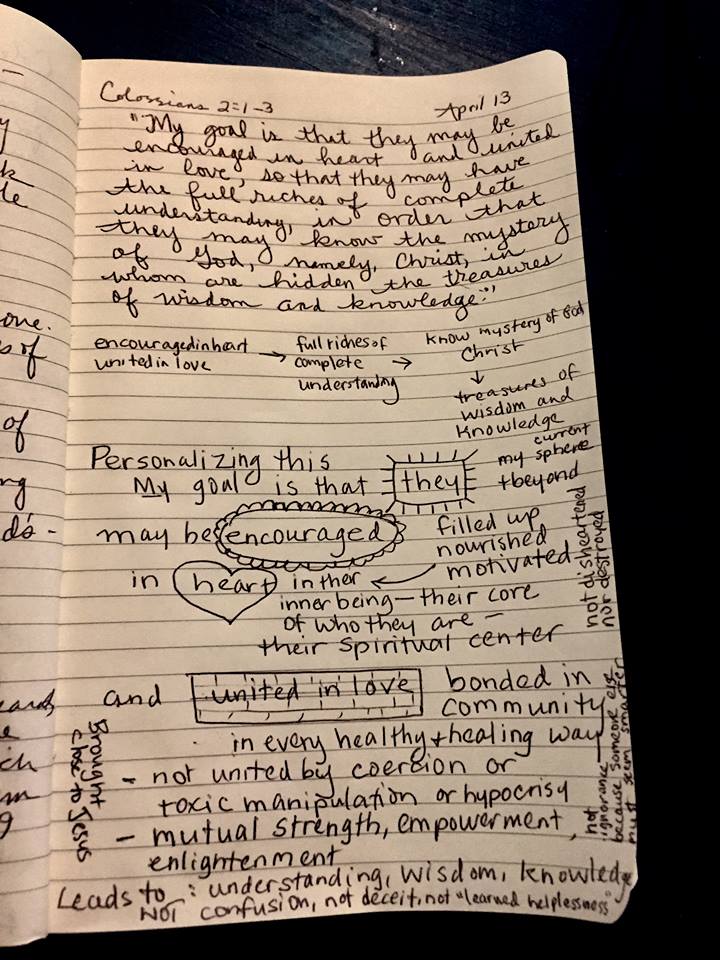
I just read Bonhoeffer's book Life Together as a Church History assignment last week, and I love how this quote coincides with my own personal Scripture study. I'm working through Colossians right now, taking notes in my journal. This isn't a formal study of a passage, as I would do for my seminary classes. It's more of the Read + Reflect + Respond approach that I've used for about 40 years. I sometimes cover only a very short section each day. 

Today I pondered Colossians 2:2-3.

My goal is that they may be encouraged in heart and united in love, so that they may have the full riches of complete understanding, in order that they may know the mystery of God, namely, Christ, in whom are hidden all the treasures of wisdom and knowledge.

This is the apostle Paul describing his strenuous and sacrificial labors as a single man traveling in the ancient world, preaching the gospel, establishing churches, and writing letters of instruction and encouragement that we still read today. 

Here is what struck me as I sought to make application to my own life and ministry as a home school mom, grandma, seminary student, crisis hotline worker, friend, and social media user. What is the best way to help people grow in life? How will they be affected by my influence? How have I been affected by the influence of others on my spiritual life?

Many of the people in my own circle, both those I've met personally and my connections on social media, have experienced a significant amount of spiritual / emotional / physical abuse in the context of the church / family / organization. They are understandably wary of any kind of God-talk because religion has been used to control and coerce them. But that is not what God has in mind!


Read the verses again with me as I offer a little informal commentary along the way...

My goal is that they may be encouraged in heart...

  • Goal: purpose, motivation, desired result
  • Encouraged: filled up, nourished, flourishing, refreshed, motivated, empowered, strengthened
  • Heart: inner being, spiritual center, core of who they are as an individual

Two questions: Is this your goal as you influence others? Is this the goal of those who are influencing you? An abuser or dysfunctional dominant leader may claim they want to lead others in the righteous ways of God, but what is the fruit? Are those in their "care" being filled up or drained out, nourished or famished, flourishing or withering, refreshed or parched, liberated or enslaved, healed or wounded, motivated or demoralized, empowered or hindered, strengthened or weakened?

...and united in love...

I see "united in love" as a healthy and healing bond. There is mutual strength, a synergy (working better together than apart) that enables greater fruitfulness. This is not a suffocating or constricting relationship. Some people think that an abusive relationship is disconnected, and in one sense it is because there is no sense of mutual partnership. However, there is a toxic bondage that throws others aside like trash but won't let them leave. Things may improve for a while, just enough to give hope that things will change. But then it escalates again, over and over. That's called the cycle of abuse, and it's why people stay instead of escaping! It's a "unity of control" but only unity in the sense that there is one person setting the agenda. That's not even true unity. It is just unilateral. 

But Colossians 2:2-3 offers a powerful contrast: wholesome bonding, being truly united in LOVE. Don't accept a counterfeit to that.

...so that they may have the full riches of complete understanding, in order that they may know the mystery of God, namely Christ, in whom are hidden the treasures of wisdom and understanding.

So being encouraged in heart and united in love is a means to further goal, which is knowing and experiencing the abundance of a spiritual life in Jesus Christ. This is a growth and enlightenment process that starts in the heart, that core of who you are. It's walking with Jesus through grace and faith, leaning into who he is and what he wants. It's not a system of pointless rules, or of conforming to the selfish expectations of others. It's an authentic transformation. An abuser communicates, "All you need to know is what I tell you." Abusers want to control the narrative. If others are under their "leadership" they don't want them to explore the Bible for themselves, seek out more education that might contradict what they are being told, have their own opinions, know enough to contradict them or hold them accountable, or be emotionally strong enough to challenge or leave them. They paralyze others through confusion, deceit, accusations, threats, trauma bonding, and religious manipulation. They communicate either overtly (in direct words) or covertly (by implication): "You are being rebellious. Rebellion is as the sin of witchcraft. I am your God-given leader. God wants you to obey me. You will never succeed unless you listen to me. God will punish you. I just want what's best for you. You are sowing discord. You are just bitter. You never want to be accountable to anyone. You are usurping my authority. You are out of line. Why don't you just let me lead? Look at me! I'm the important one here!" 

To a lesser extent, this dynamic of control can also occur inadvertently with leaders who aren't even trying to be selfish. They may think that  demanding compliance to their commands is what they are supposed to be doing as bold leaders, but this still leads to disillusioned, disempowered followers. I have often found myself slipping into this dynamic as a mother, usually as an overflow of the emotions of fear and shame. ("If I don't make them obey, I'll be a failure as a mother.")

I encourage you to evaluate your own family, friendships, churches, organizations and other your spiritually-based relationships, no matter which role you play. Does this relationship or community display the riches of God? Is this true wisdom that leads to abundant spiritual understanding? Are we growing together in our core relationships with Jesus and one another? Are we seeing Jesus as both the source and goal? Is this a treasure or a theft?

My goal is to be spiritually empowered so that I can empower others. I don't want to control or be controlled. I want to have a full life in Jesus Christ and inspire others to do the same. How about you?

Grace and peace,
Virginia

P.S. Lots of links to extend these thoughts!

Saturday, February 9, 2019

All the Way My Savior Leads Me (Strength in Hymn)


"All the Way My Savior Leads Me"
Fanny Crosby

All the way my Savior leads me,
What have I to ask beside?
Can I doubt His tender mercy,
Who through life has been my Guide?
Heav’nly peace, divinest comfort,
Here by faith in Him to dwell!
For I know, whate’er befall me,
Jesus doeth all things well;
For I know, whate’er befall me,
Jesus doeth all things well.


All the way my Savior leads me,
Cheers each winding path I tread,
Gives me grace for every trial,
Feeds me with the living Bread.
Though my weary steps may falter
And my soul athirst may be,
Gushing from the Rock before me,
Lo! A spring of joy I see;
Gushing from the Rock before me,
Lo! A spring of joy I see.


All the way my Savior leads me,
Oh, the fullness of His love!
Perfect rest to me is promised
In my Father’s house above.
When my spirit, clothed immortal,
Wings its flight to realms of day
This my song through endless ages:
Jesus led me all the way;
This my song through endless ages:
Jesus led me all the way.


About This Hymn:


This hymn was written by Fanny Crosby (1820-1915), who became blind when she was six weeks old due to a doctor's error. She wrote this hymn as a response of a curious incident of God’s providence. You can read more here: Fanny Crosby and the Story Behind the Song “All the Way My Savior Leads Me”. Fanny wrote several thousand hymns, many under pseudonyms. I remember reading her biography many years ago. She didn’t have an easy life. You can read more about her here:

Why I Chose This Hymn:


I had been musing lately on how God has led me through the nearly 43 years I have been a Christian believer. I have so many stories tucked away in my memory of odd little circumstances which set into motion long reaching ripple effects leading to huge changes in my direction. (More on that later.) So I muse and I’m amused.

Anyway, the title to this hymn came to mind during my ponderings, which is unusual since I didn’t even recognize the lyrics nor the melody when I looked it up on YouTube. (The video is at the bottom of this post.)

Reading the words “Jesus doeth all things well” at the end of the first stanza reminds me of the famous words, “All shall be well, and all shall be well, and all manner of thing shall be well” written by Julian of Norwich in her book Revelations of Divine Love. Julian was a medieval anchoress, a woman who chose to withdraw from public life to consecrate herself to a solitary life of prayer and devotion. She literally lived in a cell attached to a church, St. Julian’s, from which she took her name. I’m not planning to follow her footsteps in that, I assure you. However, I am preparing for some sort of ministry, the form of which I do not yet know. To that end, I am currently a student at Asbury Theological Seminary’s Orlando campus, and last semester I wrote a Primary Source Analysis (PSA) paper on Julian’s work for my Church History 1 class. You can read it here: Revelations of Divine Love.


The story of how I ended up at seminary is one example of God’s curious way of leading me. It involved:


  • a lifelong desire to be educated for ministry
  • a conversation with my mother about grad school several years ago before she passed away
  • a journal entry specifically mentioning Asbury Seminary even though I could not attend then
  • assorted family crises
  • ministry among other women in crisis
  • a lot of blogging about church abuse issues
  • the resulting FB friendship with a woman who blogs about the same topics on the opposite side of the country
  • that new friend’s Facebook post about the Christians for Biblical Equality conference she was attending in my city
  • a mutual FB friend (whom I had also not yet met in person) offering a scholarship so I could attend that conference
  • meeting several Methodist women at the CBE conference
  • my grandson’s rescheduled birthday party (the Sunday-morning-several-weeks-late timing of which caused me to visit a Methodist church’s early service since it was my late mother’s birthday and she had been born into a Methodist family and I had admired the Methodist women I had met at the CBE conference)
  • running into an old friend at that Methodist church (whom I had met when we worked for the same school years ago)
  • attending her Lectio Divina Bible study, and hearing her talk about her Inductive Bible Study class at seminary (a conversation which made me drool)
  • my 2018 "one word" Focus
  • and several key shifts in my own family circumstances.

And that’s just a tiny sample of the story. There is much more to it, but I don’t want to write a book here.  And all the way my Savior leads me. That much I know, even though I don’t always know what’s next on the agenda. Life is quite an adventure. I can trust God to be with me every step of the way. And then I look back and laugh.

Related links? Sure thing!

The Photos in this Post: 

The photos in this post are from my visit to the Franciscan Monastery of the Holy Land in America in Washington, D.C. last fall. I had wanted to go back to the National Cathedral the last time I visited family in Maryland. (See my poem God of Joy, I See Thee for photos of my first visit in 2017.) My nephew Doug also loves the cathedral and offered to take me. When we were driving home, I found out he had plotted a surprise detour to see the monastery too. He knew I would enjoy it, and I certainly did! I love this kind of adventure. You can see more about that here: My Birthday Weekend in Maryland

Oh, all that for one hymn post! You never know what you're going to get when you read my blogs!

Blessings,
Virginia


Tuesday, March 13, 2018

PTSD: Pain that Keeps on Giving While We Go on with Living


Dear friends,

Yesterday, I spontaneously posted the photo below on Facebook along with an analogy about PTSD. Despite the ugly photo, my words must have resonated, because as of this morning, it's been shared over 20 times, with many more likes and comments. That's not exactly viral by Internet standards, but I'm glad it's touched people.


On scars, triggers, and PTSD: In college, I was washing a Muppets promo glass from McDonald’s (remember those?) when it shattered and sliced an outer tendon of my left thumb joint. My roomie, who hated the sight of blood, rushed me to the ER and bravely sat with me while the surgeon repaired the damage. My hand was in a brace for six weeks - which made it nearly impossible to write since I’m a leftie. I had to take class notes with my right hand. Later, after the stitches came out, I had to do PT exercises to regain the use of my left hand. 

So, I’m all healed up, right? Well, except for the circular scar. And the constant numbness which I’ve learned to mostly ignore. And... Today, 35 years later, I was cleaning the toilet and bumped that edge of my hand. I shrieked! I may or may not have let a mild epithet fly. You see, though I don’t often consciously think of my hand injury, it’s still there! And if it gets bumped hard, which happens at least once a year, it’s quite painful! My hand is still throbbing a half hour later! 

It made me think of PTSD from emotional wounds. Some people think that if a traumatic incident happened a long time ago, and the time of crisis has passed, that it’s a done deal. It’s not. The person may not think of it as often or seem as deeply affected as more time goes on, but then what looks like a trivial trigger pops up and WHAM! Aaagh! I myself had an ugly cry just last night when a painful memory resurfaced. It took me a little while - and half a box of Kleenex - to find my calm again. And there is nothing wrong with that at all. 

So folks, just think about that when you are talking to or about trauma survivors, OK? Don’t chide them for not being OVER IT already. Their pain might make you uncomfortable and you may not want to deal with it. You want them to stuff it so you can’t see it. But like my squeamish roommate, love sits with the wounded. Even when the trauma rears its ugly head weeks, months, years, or even decades later. Let them own their pain. Create space for them to grieve and re-heal. And learn to be gentle with yourself too.

#metoo #PTSD #trauma #CreateSpace #empathy 
#innerhealing #tenderspots

~*~*~

So here are my followup thoughts to the original post:

PTSD (Post Traumatic Stress Disorder) is the pain that keeps on giving. I know it because I have lived it, though fortunately it does not still bother me that often or that intensely.

I do totally understand about moving on and releasing bitterness, not wallowing in negativity or being crippled by shame or anger or depression. This is not about that. It's about what happens when you are taking the necessary steps to recover your wholeness, but the pain keeps popping back up at unexpected times. It's about giving ourselves grace and not allowing this to suck us back into the dark vortex. 

When the painful memories resurface, this inner voice in our souls can whisper, "You'll never be free. You may as well just give up. You are doomed to a life of mental torture and it will destroy your physical health, too." 

Then we can, with practice and support and emerging courage, reply, "The pain will come and I'll deal with it when it does, with the help of God and the knowledge I have received and the support of wise people who care. I have decided that my past won't stop me from building my healthy new future. That story was not the last chapter in my book, and I'm choosing a happier ending."

And when that pain comes again and again and again, we don't take it as a verdict that we have failed in recovery. Instead, we deal with it, pick up our broken pieces, stick them back in place the best we can (gently!), and keep moving. I know it's much more complex than that, but this is the simple mental picture I use when I'm in the middle of it. 

Maybe our coping strategies aren't the optimal ones yet.  Maybe they are hurting more than they are helping. We can assess that as we go along and make the necessary adjustments. We learn more and we seek help to do whatever it takes to move forward, treat the root causes, and not just mask the pain.

This is what resilience is all about. It's not that we won't face obstacles, because we always will - whether it is old ones or new ones. It's that we rise to meet these challenges as courageously as we can. We might be "quaking in our boots" but I reckon we can walk and quake at the same time.

Two poems from my heart:


"Pilgrimage and Jubilee"
by Virginia Knowles

It’s been a long road
And I’ve traveled the valley of the shadow.
But I write as a free woman
Still with earthy bonds, yes
But able to rise above and go beyond.

We are called to the dignity
Of the Image of God.
We are called to walk the path
Of peace and glory.
We are called to hear the holy echo:
"Proclaim liberty throughout the land!"
So let us rise, strong and free.

Mine is the story of pilgrimage and jubilee.


~ and ~


"Lift Up Your Head and Laugh"
by Virginia Knowles

“Lift up your head and laugh!”
He spoke as a prophet.
But what did he know those thirty odd years ago?
What did he know of my future?
I was still so young then
With only a taste of raw and broken
And visions of a whole life open before me
Certainly not knowing quite what to expect
But with dreams and plans nonetheless:
Happily ever after with maybe
A few little bumps along the way…
Why not? And why not laugh?
Life could be, would be, one grand adventure.

It’s been a rather curious life indeed
This grand adventure of mine.
Now I shake my head and laugh
At myself, at how I clung to so much
That prickled and burned and then gave way.
Yet mysteries and marvels
Came to me when least expected
Laughter mixed with tears and sighs
And more than a few bumps along the way
So much good and so much grief mingled in
So much for dreams and plans!
A worthwhile journey still,
Just not how I thought it would be.

It’s not just me, I know
I watch the world walking by
And I try to understand, wonder
Where it is going: out and about
And home again, home again
A million silent stories walking by
A million mingling stories of mourning and mirth.

I have lived long and learned much
And I find myself speaking to the young ones
With their whole lives open before them
The words of the timeless sage
Thirty hundred years ago:
“There is a time for everything…
A time to weep and a time to laugh.”
They have seen me weep, and I will weep again.
But for now, I will lift up my head and laugh.


~*~*~


I've written a lot more encouragement, trauma-related information, and poetry on three of my blogs. Here are the links I think will fill a need to those reading today.

Inspirational posts from my blog This Mom Grows Up:


Posts related to trauma from Watch the Shepherd:


Poems from my blog Virginia's Life, Such as It Is:

~*~*~

Can I just say how much I appreciate those who have been so faithful to educate about trauma and PTSD? I am immensely grateful to the resources that survivors and their allies have online, in print materials, and in face-to-face support groups. We need to fully realize what is going on inside and how to best care for those affected by trauma. 

It is my goal this spring and summer to research more about wisely caring for other people. I want to be one who help them move toward healing and fulfillment and success in life, just as I am trying to do in my own life.

One of the books I plan to buy soon is Suffering and the Heart of God: How Trauma Destroys and Christ Restores by Dr. Diane Langberg. I'd love to hear what other resources you have found helpful. Please leave a comment!


That's about all for now!

I'd love to hear your thoughts!

Shalom,
Virginia


Tuesday, March 29, 2016

Five Things Home School Moms Should Know About Abusive Marriages


Five Things Homeschool Moms Should Know About Abusive Marriages
by Virginia Knowles

(Note: This article was originally requested by Ryan Stollar of Homeschool Alumni Reaching Out and first appeared as a guest post on their blog yesterday: Five Things Homeschool Moms Should Know About Abusive Marriages.)


When our family started the homeschooling journey about 25 years ago, I envisioned my comrades in the movement as the ideal examples of healthy marriage and parenting. I have learned much along the way about educating and nurturing my own ten children, and I am seeing this legacy continue with my six grandchildren. However, as the years have gone by, I have had to lay aside my cute little rose-colored glasses and acknowledge that there can also be a dark side. Abuse, whether it is against a child or a spouse, is a tragic reality in far too many homeschooling families. Because I write frequently on the topics of domestic violence and other forms of family dysfunction, HARO has asked me to share five things that homeschool moms should know about abusive marriages.


1. Homeschool moms are not immune from abusive marriages.


How many of us started out thinking that homeschooling would guarantee us harmonious families? Educating at home can help this effort in many ways, but it is not a magic potion. There are even facets of homeschooling, such as greater responsibility and stretched resources, which put families at increased risk of stress. We must never justify abuse due to these factors, but they can bring latent harmful tendencies to the surface and then compound them.


Worse yet, homeschooling often attracts fathers who already feel a high need for psychological control over others. (Yes, women  can be this way too, but that is beyond the scope of this article.) Fathers may try to exert this control with intentions of raising superior children, but it backfires because good fruit does not come from the bad root of a domineering personality. Common homeschool movement teachings about authority, child training, and gender roles can enable these unhealthy control issues, which can in turn fuel abusive behavior. A man who craves power can easily become a tyrant and a bully against his wife and children, while justifying it by twisting Scripture.


A mother has the moral and legal obligation to shield her children from abuse. Though right and necessary, this puts her at risk of injury. He may shove her out of his way, which could bruise her or cause her to fall and break a bone. She may suffer joint or muscle damage while trying to pull him away from or off of a child. He may impulsively hurt her in retaliation without thinking much about what he is doing. These are forms of domestic violence against his wife, even if he is not intentionally beating her up, and even if she does not have noticeable or lasting injuries. Beyond that, a homeschool dad may purposely and maliciously hurt his wife - physically or emotionally - as a way of dominating her or “punishing” her for her supposed shortcomings.  


If a homeschool mom feels she must defer to her husband in everything, or she is trying to protect her family’s Christian reputation, or if she has no financial resources or current job skills to support her family, then she can feel she has little recourse when the marriage turns toxic. If she protests or even offers an alternative opinion, she is often labeled as rebellious, told she will ruin her children, and intimidated with threats. This shaming and fear is often reinforced by her church leaders and homeschool friends who do not fully understand the dynamics of abusive relationships. If she has been conditioned to distrust or even fear government  or community resources, she is at a further disadvantage.


I cannot even begin to tell you how many Christian homeschool moms I know who have been in abusive marriages for far too long, and feel like they have no choice but to put up with it. This has to stop.  Even if you don’t think domestic violence personally affects you, please read these articles and the others I have linked later:


2. Abuse in marriage is not just physical.  


Physical violence is not the only way a man can abuse his wife.


Abuse also includes threats, ridicule, coercion, manipulation, intimidating body language, playing mind games like gaslighting, humiliating her in front of others, isolating her from friends and family, denying access to resources (finances, medical care, transportation, information, counseling), neglecting to follow through on promises and responsibilities, blocking her exit from a room, damaging her possessions, blaming her for the abuse, alienating her from her children, and more. You can see this by looking at the Power and Control Wheel.


Again, a wife is particularly susceptible to these forms of relational abuse if she believes that she must comply with her husband’s demands for authority. Because her husband has not physically injured her, she may not realize that he is still abusive. She may acknowledge that something is wrong, but think that she herself is the problem. She may attempt to work on marital intimacy, a more cheerful and submissive attitude, better child training, a cleaner house, and everything else she can think so that her husband will treat her better. What she needs to realize is that she is being abused, and that the necessary response is much different. The marriage is not just difficult or dysfunctional, but destructive and dangerous.


Recognizing abuse can be particularly confusing because it often occurs in unpredictable cycles of repeating phases: tension building (increased frustration, conflict, withdrawal, mood swings, pressure to comply), acute explosion (aggressive crisis incident that may either “come out of nowhere” or be intentionally escalated by the abuser), honeymoon (active attempts by the abuser to rebuild trust through apologies, compliments, promises, gifts, favors, spiritual activity, counseling, etc.), and calm (settling down, forgetting, minimizing, relief, normalcy). It is important to realize that even in the lull after an explosive incident, the husband is most likely still emotionally abusing her through other means, whether she realizes it or not. Again, it is important to recognize the many forms of abuse in order to realize the continued gravity of the situation.


Here are some more resources to read about recognizing the forms of marital abuse, and realizing why so many women stay.


3. Children are at risk of lasting damage when abuse is present in a marriage.


While you started homeschooling to nurture and care for your children, if your marriage is abusive, they are not in a safe and healthy environment. Most states consider it child abuse when children witness abuse between their parents. In extreme cases, you can be held liable and lose your children if you do not take appropriate action to protect them from the consequences of their other parent’s abuse. Think carefully about all of this if you are “staying together for the sake of the children.” You may be doing more harm than good.


At the most basic level, the stress of seeing abusive behavior in their parents’ marriage can create emotional disturbance which will also affect physical health. Depression, anxiety, eating disorders, bedwetting, self-harming, and defiance are common side effects. Children often internalize parental conflict and blame themselves. Or they can turn their anger and aggression against other people and become bullies themselves. If your children have been affected in any way by abuse in the home, please seek medical help and mental health therapy for them and yourself as soon as possible. If you don’t think you can afford this, call a community mental health or child protective organization for assistance.


A child is at additional risk for physical injury as an innocent bystander to domestic violence, especially if the child attempts to protect the mother, or if the father hurts the child as a way of causing extra distress to his wife. No child is safe if the father is throwing things, shoving his wife, slamming doors, or other manifestations of rage. In addition, a mother who is being abused can in turn blame her children, and then treat them in harsh and injurious ways.


While the mother is dealing with the distress in her marriage, she can easily be distracted from providing an adequate education for her children. They can also be too stressed out to focus on their assignments. While there are certainly times to lay aside formal academics to deal with family issues, if they cannot regularly attend to homeschooling because of this, then something needs to change.


Finally, marital abuse exposes children to a powerfully toxic example of a dysfunctional relationship which they may normalize (see as the usual) and then carry forward into their own romantic and parental relationships. Depending on how they process the experience, they may be more likely to tolerate or perpetrate abusive dating or marriage relationships, as well as perpetuate abusive practices with their own children. It is important for them to understand what is happening, know that it is wrong, and develop strategies to keep themselves safe for their present and future.


See also:


4. Decisive action is necessary, and sometimes it has to be drastic.


Unfortunately, abuse does not just go away on its own. A mother must take decisive action to ensure safety and sanity for herself and her children. Here are several things she might do, starting out with the basics and ramping it up as necessary:


  • assess the situation to acknowledge exactly what has happened in the past and what the current and future risk is
  • strengthen her confidence and resolve to move forward into a safe and healthy family life
  • educate herself on the dynamics of abuse, which will involve reading and focused research
  • break the silence and share her story with a supportive network of friends, family, and trustworthy on-line forums
  • seek appropriate professional help (more on that in the next section)
  • set and enforce firm boundaries with specific consequences
  • determine her optimal alternatives if those boundaries are not respected
  • make safety/exit/escape plans and preparations in case the situation escalates
  • separate from the abuser, which may entail persuading him to leave the home, having him removed from the home, or moving out with her children
  • go “no contact” to prevent harassment by phone, texts, messaging, e-mail  
  • file a restraining order to keep the abuser away from the family and home
  • as necessary, file for divorce as an increased legal protection against continued abuse


Please note that while each of these steps can lead to more clarity and progress, none of them will guarantee an end to the abuse. In fact, the risk of retaliation can increase each time a woman takes initiative to distance herself further from her abuser. This should not dissuade her from taking action, but at all points she needs to be extra vigilant and not let her guard down as she moves forward to safety and dignity.


Depending on the severity of the situation, it may be necessary for the children to transition into other formats of education so that their mother can focus on the actions necessary to protect and provide for the family. This could involve homeschooling with outside assistance (hybrid school, co-op, online programs, grandparents) or enrolling some or all of the children in traditional full-time schools. This doesn’t have to happen immediately. A mother might set a goal of preparing her children for the change within a certain time period as she simultaneously works through her own future options. If a woman’s identity is wrapped around mothering and homeschooling, any of these transitions can be an uncomfortable sacrifice for her. She will appreciate compassionate understanding and support from her network of homeschool friends. She can know that she is doing her best to nurture her children, even if this was not part of her ideal plan.


Here are some other articles about taking action against abuse in marriage:


5. Help is available, but you have to know where to look.


Taking action in a domestic violence situation can be confusing and intimidating. A woman’s access to solid help in the form of reliable information and practical assistance can make a huge difference in how she is able to proceed.


Often, her first step is reaching out for advice and emotional support from family, friends, and religious leaders whom she already personally knows. How they respond is crucial. They can either move her toward safety and healing, or send her back into the lion’s den. Will they believe her story? Not always. Many domestic violence survivors are accused of misunderstanding, exaggerating, or worse yet, lying about their circumstances. Even if they are believed, they are often advised to forgive their offender, patch things up, and work on their own problems without setting appropriate boundaries or separating from the abuser. Yikes! At this point, a woman may give up trying to change the situation and just keep muddling and agonizing, questioning her own perception of reality. However, if she keeps talking about it or or finds someone else who will listen to her, she will hopefully find some support in her own personal network.


This facetious list by a domestic violence survivor and (former) homeschool mother of 12 can help others know how to best respond:


The reaction of a woman’s pastors and elders is also key, but this can get confusing, too. They may know and trust her husband, and be reluctant to acknowledge a serious problem if he seems like a normal, caring human being. Or they may be so fixated on preserving marriages in the congregation that they are unwilling to entertain the potential necessity of a separation or divorce. Or they may not have professional training in the area of domestic violence, and counsel the couple as if they had a difficult marriage instead of a dangerous and destructive one. If they use a nouthetic or so-called “Biblical” approach to counseling, they may blame the wife and tell her to deal with her own sins in the marriage. Or they may say something to the husband about the alleged abuse that embarrasses him, and he in turn takes it out on his wife. On the other hand, think of the good that would result if pastors sought professional level skills in crisis counseling, and took a broader and deeper view toward God’s heart for families. At the very least, a pastor should be able and willing to refer domestic violence victims to professional counselors in the community who are educated and experienced in this specialty, as well as gain a basic understanding of the issues. He or she can find out more at these links:


One very important thing to know is that couples counseling - whether pastoral or professional - is not at all recommended when the dynamics of abuse exist in a relationship. This is rarely (if ever) effective and puts a wife at additional risk of abuse and retaliation. Both parties do need counseling, but it should be individual. If they use the same counselor, there must be an absolute guarantee of confidentiality.


Beyond a woman’s existing personal circle of friends and family, there is much help available in the community. She can research information and participate in support groups on the Internet, check out books at the library, call a domestic violence crisis line, seek help at a women’s shelter, get professional counseling (can be faith-based and may be covered by insurance), apply for government financial and medical assistance, and find a referral for affordable (maybe subsidized) legal help.  Here are some links for these community resources:


This is a lot of information to process right now. If you or someone you know is affected by domestic violence, please read more and come back to it again, even if it is just a little at a time. Let it sink in. Think about what you need to do next for yourself or someone else, and start taking steps in that direction. What you know, what you say, and what you do about domestic violence can make a difference not only now, but for generations to come. Let me know if you
need help.