Showing posts with label Gender ~ Authority. Show all posts

Saturday, April 13, 2019

The Goal is Not Control, But Empowerment


"Has the community served to make individuals free, strong, and mature, or has it made them insecure and dependent? Has it taken them by the hand for a while so that they would learn again to walk by themselves, or has it made them anxious and unsure? This is one of the toughest and most serious questions that can be put to any form of everyday Christian life in community." Dietrich Bonhoeffer, Life Together

I just read Bonhoeffer's book Life Together as a Church History assignment last week, and I love how this quote coincides with my own personal Scripture study. I'm working through Colossians right now, taking notes in my journal. This isn't a formal study of a passage, as I would do for my seminary classes. It's more of the Read + Reflect + Respond approach that I've used for about 40 years. I sometimes cover only a very short section each day. 

Today I pondered Colossians 2:2-3.

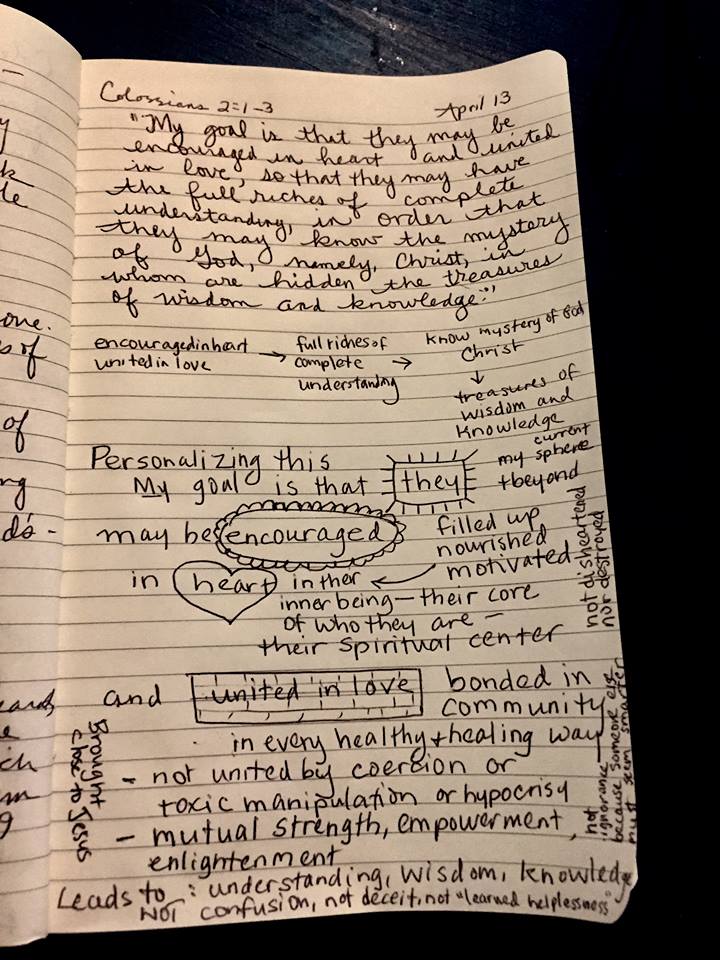
My goal is that they may be encouraged in heart and united in love, so that they may have the full riches of complete understanding, in order that they may know the mystery of God, namely, Christ, in whom are hidden all the treasures of wisdom and knowledge.

This is the apostle Paul describing his strenuous and sacrificial labors as a single man traveling in the ancient world, preaching the gospel, establishing churches, and writing letters of instruction and encouragement that we still read today. 

Here is what struck me as I sought to make application to my own life and ministry as a home school mom, grandma, seminary student, crisis hotline worker, friend, and social media user. What is the best way to help people grow in life? How will they be affected by my influence? How have I been affected by the influence of others on my spiritual life?

Many of the people in my own circle, both those I've met personally and my connections on social media, have experienced a significant amount of spiritual / emotional / physical abuse in the context of the church / family / organization. They are understandably wary of any kind of God-talk because religion has been used to control and coerce them. But that is not what God has in mind!


Read the verses again with me as I offer a little informal commentary along the way...

My goal is that they may be encouraged in heart...

  • Goal: purpose, motivation, desired result
  • Encouraged: filled up, nourished, flourishing, refreshed, motivated, empowered, strengthened
  • Heart: inner being, spiritual center, core of who they are as an individual

Two questions: Is this your goal as you influence others? Is this the goal of those who are influencing you? An abuser or dysfunctional dominant leader may claim they want to lead others in the righteous ways of God, but what is the fruit? Are those in their "care" being filled up or drained out, nourished or famished, flourishing or withering, refreshed or parched, liberated or enslaved, healed or wounded, motivated or demoralized, empowered or hindered, strengthened or weakened?

...and united in love...

I see "united in love" as a healthy and healing bond. There is mutual strength, a synergy (working better together than apart) that enables greater fruitfulness. This is not a suffocating or constricting relationship. Some people think that an abusive relationship is disconnected, and in one sense it is because there is no sense of mutual partnership. However, there is a toxic bondage that throws others aside like trash but won't let them leave. Things may improve for a while, just enough to give hope that things will change. But then it escalates again, over and over. That's called the cycle of abuse, and it's why people stay instead of escaping! It's a "unity of control" but only unity in the sense that there is one person setting the agenda. That's not even true unity. It is just unilateral. 

But Colossians 2:2-3 offers a powerful contrast: wholesome bonding, being truly united in LOVE. Don't accept a counterfeit to that.

...so that they may have the full riches of complete understanding, in order that they may know the mystery of God, namely Christ, in whom are hidden the treasures of wisdom and understanding.

So being encouraged in heart and united in love is a means to further goal, which is knowing and experiencing the abundance of a spiritual life in Jesus Christ. This is a growth and enlightenment process that starts in the heart, that core of who you are. It's walking with Jesus through grace and faith, leaning into who he is and what he wants. It's not a system of pointless rules, or of conforming to the selfish expectations of others. It's an authentic transformation. An abuser communicates, "All you need to know is what I tell you." Abusers want to control the narrative. If others are under their "leadership" they don't want them to explore the Bible for themselves, seek out more education that might contradict what they are being told, have their own opinions, know enough to contradict them or hold them accountable, or be emotionally strong enough to challenge or leave them. They paralyze others through confusion, deceit, accusations, threats, trauma bonding, and religious manipulation. They communicate either overtly (in direct words) or covertly (by implication): "You are being rebellious. Rebellion is as the sin of witchcraft. I am your God-given leader. God wants you to obey me. You will never succeed unless you listen to me. God will punish you. I just want what's best for you. You are sowing discord. You are just bitter. You never want to be accountable to anyone. You are usurping my authority. You are out of line. Why don't you just let me lead? Look at me! I'm the important one here!" 

To a lesser extent, this dynamic of control can also occur inadvertently with leaders who aren't even trying to be selfish. They may think that  demanding compliance to their commands is what they are supposed to be doing as bold leaders, but this still leads to disillusioned, disempowered followers. I have often found myself slipping into this dynamic as a mother, usually as an overflow of the emotions of fear and shame. ("If I don't make them obey, I'll be a failure as a mother.")

I encourage you to evaluate your own family, friendships, churches, organizations and other your spiritually-based relationships, no matter which role you play. Does this relationship or community display the riches of God? Is this true wisdom that leads to abundant spiritual understanding? Are we growing together in our core relationships with Jesus and one another? Are we seeing Jesus as both the source and goal? Is this a treasure or a theft?

My goal is to be spiritually empowered so that I can empower others. I don't want to control or be controlled. I want to have a full life in Jesus Christ and inspire others to do the same. How about you?

Grace and peace,
Virginia

P.S. Lots of links to extend these thoughts!

Saturday, February 9, 2019

Revelations of Divine Love by Julian of Norwich (Primary Source Analysis for Asbury Seminary)


Revelations of Divine Love

by Julian of Norwich 

This is one of my Church History assignments from last semester at Asbury Theological Seminary. For a Primary Source Analysis (PSA), a student must read the historical document, and then follow a series of writing prompts. Last semester, we had several options to choose as subjects for our two PSA projects, and I chose Athanasius's work On the Incarnation for my first, and Julian's Revelations of Divine Love for my second. This semester, for Church History 2, I am likely to choose Women’s Speaking Justified (1666) by Margaret Fell and Enquiry into the Obligation of Christians (1792) by William Carey.

Primary Source Analysis:
Revelations of Divine Love 
by Julian of Norwich 

Summary

Revelations of Divine Love is Julian of Norwich’s expression of a series of 16 visions she received while she was deathly ill for several days at the age of 30. In the introduction, she explains her purpose in writing and the circumstances of her infirmity and complete healing, then briefly recaps the theological themes of each of her visions. These are mostly related to the Passion of Christ, the great love of God, and the spiritual bliss and peace experienced when believers are “grounded” and “oned” with God.

Julian first wrote a short version of her Revelations, but expanded it with additional meditations about 20 years later. There are no extant manuscripts for the earlier version, and the only complete ones for the later one date from the 17th century. Her longer book has 85 chapters, which are not evenly split between the 16 visions, as some were much more descriptive than others. The complete form of Revelations of Divine Love is considered one of the great Christian classics, and was the first female-authored English-language book still in print.

Historical/Theological Context

Julian of Norwich, born in 1342 in England, was a medieval anchoress, a woman who chose to withdraw from public life to consecrate herself to a solitary life of prayer and devotion. We don’t know her actual name, but St. Julian is name of the church where she lived as a recluse for most of her life. She was also known as Juliana. According to The Book of Margery Kempe, Julian was sought out as a spiritual counselor by those who visited her in her cell. Very little is known of Julian apart from what she has written in this book.

Julian was not the only female medieval mystic in Europe. Hildegard von Bingen of Germany, who preceded her by over a century, and Catherine of Siena, Italy, who lived at about the same time as Julian, also recorded extensive divine visions which have survived to modern times.

In English theology, Julian was a contemporary of reformer John Wycliffe. It is notable that he did not begin his English translation efforts until 1380, which would have been after Julian’s visions. Thus, she would not have had access to English Scripture, and would have had to have either known Latin or relied on the teachings of other clerics for her knowledge of the Bible.

Author’s Intention

Julian’s intention for recording her Shewings (as she called them) was to share her experience so that others could better understand divine love and thus draw closer to God in intimate communion. It does not appear that she had any interest in promoting herself by writing; her humility prevented her from overshadowing the glorious visions which magnified the God she loved so much. She refers to herself merely as “a simple creature unlettered.” She aimed to promote reverence and hope, as well as wholehearted devotion.

Central Themes

The passion of Christ: Julian vividly described her impressions of Jesus during the days surrounding his crucifixion, with special attention paid to physiological aspects such as sweating blood, shedding blood, becoming dehydrated, his skin changing color, and his side being riven open. This seems similar to the fascination that the Moravians later had with the physical wounds of Christ.
Of the brownness and blackness, the ruefulness and wastedness of this Image many marvel how it might be, since that He portrayed it with His blessed Face who is the fairness of heaven, flower of earth, and the fruit of the Maiden's womb. Then how might this Image be so darkening in colour and so far from fair?--I desire to tell like as I have understood by the grace of God.
Being “grounded” and “oned” with God: This concept is repeated throughout the book. “Grounded” refers to God being our foundation and source, while “oned” is being united in intimate communion with God.
For our Soul is so deep-grounded in God, and so endlessly treasured, that we may not come to the knowing thereof till we have first knowing of God, which is the Maker, to whom it is oned.
Spiritual bliss: The theme of bliss appears throughout the book. Julian assures her readers that this is what God wants for us, rather than living in shame or despair.
GLAD and joyous and sweet is the Blissful lovely Cheer of our Lord to our souls. For He [be]holdeth us ever, living in love-longing: and He willeth that our soul be in glad cheer to Him, to give Him His meed. And thus, I hope, with His grace He hath [drawn], and more shall draw, the Outer Cheer to the Inner Cheer, and make us all one with Him, and each of us with other, in true lasting joy that is Jesus.
Peace and Hope: Julian was confident that God would bring good out of every situation in life, because he is good, wise, and able. The last passage listed below contains the words for which Julian is most known, here italicized.
Thus saw I that God is our very Peace, and He is our sure Keeper when we are ourselves in unpeace, and He continually worketh to bring us into endless peace.
Behold and see! For by the same Might, Wisdom, and Goodness that I have done all this, by the same Might, Wisdom, and Goodness I shall make well all that is not well; and thou shalt see it.
And for the tender love that our good Lord hath to all that shall be saved, He comforteth readily and sweetly, signifying thus: It is sooth that sin is cause of all this pain; but all shall be well, and all shall be well, and all manner [of] thing shall be well.
On questioning about this, Julian is told that if God can bring about salvation after the sin of Adam, the worst that has ever happened, he can make all other things well, too.

The Motherhood of Both the Virgin Mary and Jesus: The entire Eleventh revelation is about Jesus showing his mother to Julian three times. She is also mentioned often in the other revelations. But then she also characterizes Jesus as a heavenly Mother in her extended comments after the first fourteen Revelations.
And in this sweet word [it was] as if He had said: I wot well that thou wouldst see my blessed Mother: for, after myself, she is the highest joy that I might shew thee, and most pleasance and worship to me; and most she is desired to be seen of my blessed creatures.
The Mother may lay the child tenderly to her breast, but our tender Mother, Jesus, He may homely lead us into His blessed breast, by His sweet open side, and shew therein part of the Godhead and the joys of Heaven, with spiritual sureness of endless bliss.
The all-encompassing love of God: As indicated by the books title, Divine Love is the main theme of the Revelations, and accordingly it appears throughout the book. It is fitting then, that Julian ends her final Revelation with these words:
And I saw full surely that ere God made us He loved us; which love was never slacked, nor ever shall be. And in this love He hath done all His works; and in this love He hath made all things profitable to us; and in this love our life is everlasting. In our making we had beginning; but the love wherein He made us was in Him from without beginning: in which love we have our beginning. And all this shall we see in God, without end.
Positive and Negative Features

I admire both Julian’s perception and her devotion to God, which are quite challenging to me in much different circumstances. I am most charmed by her tender (and often archaic) vocabulary, such as dearworthy, full lovely, mirth, bliss, weal, solace, love-longing, courteously, All-Wisdom, and Benedicite Domine. I love the metaphors and analogies she uses, such as being wrapped in God like clothing, or that “All-Thing” (everything) created is as insignificant as a hazelnut yet still deeply loved by its Creator. Her writing is both detailed and imaginative, which might have been enhanced as a result of her expansion of the manuscript in later years.

The main negative aspect I perceived is that her understanding of the doctrine of atonement seems to not align with the more classical views that I hold. Even her viewpoint on this resonates with me, though. She also believed in Purgatory, a doctrine I believe to be without Biblical merit. Some of her descriptions make me uncomfortable as well, but that is not necessarily a detriment.

Modern Application for the Church

Revelations of Divine Love has several applications for the modern church to consider, with various aspects most needed according to theological emphases of different movements.

The book’s theme of God’s love, as opposed to his wrath, might initially appeal to those in the church who prefer to focus on the more pleasant and positive aspects of the faith, especially those related to emotional fulfillment. To these believers, Julian’s treatises on the Passion of Christ, as well as her own lifestyle, would also be both instructive and corrective toward a more rigorous reverence, consecration, and service. Those who tend to be self-absorbed and consumed with grand success would do well to think on her ideas of the smallness of humankind in relation to their All-Being Creator.

On the other hand, that same rapturous description of the generous and warm love of God toward his creation might also serve to temper the legalistic tendencies of those in the modern church who see God only as wrathful and exacting. It is the compassion of Christ which enraptured and captured Julian’s heart, not a regimented checklist of doctrines and behaviors.

Related to that, but also distinct, is that many of Julian’s meditations feminize God’s characteristics. That, combined with her own medieval womanhood, could be quite refreshing to those who have experienced the more patriarchal edge of the modern church, where modern women still have no voice and where promoting masculinity and male privilege seem to be the operative priority.

It is interesting that Julian expanded her writing much later on. That is an indication that Christians can benefit from revisiting what God has shown them earlier, evaluating the central message, exploring the ideas further, and using that as a springboard for later ministry. This is perhaps part of what has made her work so enduring for well over 600 years.

To believers in every time period, Julian’s exhortations about being “grounded” and “oned” with God serve as a call to a much deeper and more beautiful communion between believers and their Creator. The 21st century church seems to be sadly lacking in authentic and transformative faith, settling instead for shallow caricatures of who Jesus is and what he wants to do in the life of his saints. May God grant revival to his people even now.


~*~*~*~

That assignment was for Church History 1.
Here is one I did for my Inductive Bible Study course.

Inductive Bible Study on Discipleship in Matthew 8-9 (Seminary Notes)

You may also like my post:

Wednesday, October 3, 2018

Domestic Violence: What to Know and What to Do


Dear friends!

October is Domestic Violence Awareness Month! Tomorrow evening, I am speaking at a small church (in a home) about how Christians can respond to domestic violence victims. To help prepare for that, I decided to update this list of my own blog posts on the topic (the blue and gray links), as well as other related web links (the brown links). 

I hope that this post will give you resources and courage to help yourself or someone else find safety and sanity. Please know that my heart and prayers are with you. I would be delighted to hear from you, so feel free to e-mail me.

If you are using a computer that others also use, and you need to visit web pages discretely for safety's sake, please stop for a moment consider whether you can proceed without undue risk. You may try using an incognito browser, but if somebody has placed keystroke tracking software on your computer, you are still at risk. Consider going to a friend's house or a public library to use a different computer.


On this page you will find links to articles on my own blogs and other sites, phone numbers, books, and Central Florida domestic violence centers. Please note that I do not endorse everything at these sites or by these organizations. I trust that you will use your own discretion. Also please note that many of the links within the blog posts may be obsolete, but the ones on this page should work.

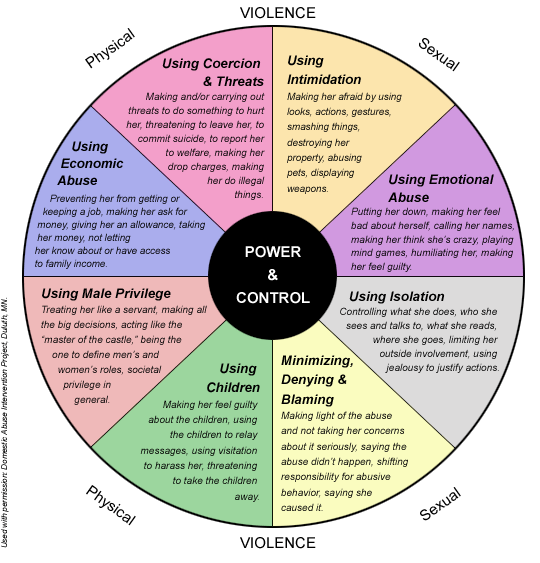
Please realize that though I am using the phrase "domestic violence" in the blog post title, there are many more forms of domestic abuse beyond physical violence. These include coercion & threats, intimidation, emotional abuse (which includes spiritual abuse), isolation, minimizing / denying / blaming, using children, male privilege, and economic abuse.


It is also important to note that even if a situation seems calm at a given moment, there may still be a continuing "cycle of violence." It's not the abuse stops, but that the outward forms of it go dormant for a while. It is still an abusive relationship that can escalate at any time.


The sections in this blog post:

  • Phone Numbers
  • Domestic Abuse in Christian Marriages
  • Domestic Violence Basics
  • Practical Help & Safety Planning
  • Counseling & the Psychology of Abuse
  • How Christians & Churches Can Help Abuse Victims, Promote Mutual Respect, and Empower Women
  • Dating Violence
  • Domestic Violence and Children
  • Central Florida Resources


Phone Numbers
  • National Domestic Violence Hotline: (800)799-7233
  • USA Domestic Abuse Hotline: (800)999-SAFE


Domestic Abuse in Christian Marriages


Counseling & the Psychology of Abuse


How Christians & Churches Can 
Help Abuse Victims,
Promote Mutual Respect,
and Empower Women
Central Florida Resources 

  • Safe House of Seminole: A confidential shelter for victims of domestic violence and their children, includes counseling, practical support, legal help, etc. 
  • Harbor House (Orange County): Shelter for victims of domestic violence, includes counseling, practical support, legal help, etc. 
  • Elizabeth House: Faith-based transitional home in Seminole County where victims and their children can stay for several months and receive supportive services.
  • Kids House of Seminole Children's Advocacy Center: Help for families dealing with child abuse; friendly, non-threatening atmosphere; includes counseling, support, information on resources, referrals for substance abuse treatment, etc.
  • Heart of Florida United Way 211: Extensive database of human services available in central Florida, such as financial assistance, shelters, counseling, etc. You can also dial 211 to get this information and a listening ear over the phone. (Note: I am an employee in the 211 call center.)

Wednesday, June 6, 2018

The Power of a Christian Woman's Voice


A voice.
A Christian voice.
A Christian woman's voice.
The Christian woman's powerful voice.

What thoughts come to your mind?
Did you flinch? Wince? 

Maybe you heard an inner voice intone: "Women must be silent, quiet, demure, deferential... Don't rock the boat. Just don't. Better to say nothing."

Or maybe you heard, "Yes! It's about time! Rock on! Girl power!"

Or maybe you heard both. Either way, you're not alone.

I am a Christian woman, learning to lift my voice. 

In too many church communities, women's voices are silenced, to one extent or another. Sure, they can chatter among themselves about mothering, cooking, housework, home schooling, and other feminine matters. But anything weightier than that is a man's turf. The men will talk it over, make decisions, take care of all the hard things. 

But what if they don't care, or they botch it, or they abuse their position? Well, just hang tight and trust God until they get it right or get it at all. Speak up about it? No, a woman has no authority over a man, and speaking up is considered a challenge to his authority. A woman has no authority even over herself. A woman has no real choice, no real voice. She is just the passive recipient of whatever a man, or group of men, chooses for her. If she doesn't like it, tough luck, she's stuck! She can just pray about it. That's a reality for far too many Christian women in far too many churches and families. (This seems even ludicrous to type, like it's a scene out of A Handmaid's Tale. But it's not.)

But isn't that just the way God decreed it to be? Isn't that what the Bible says?

No. It isn't. No. It doesn't.
Plus, we can evaluate truth by fruit.
So let's look at the fruit of silencing women. 
It's rotten.

The Rotten Fruit of Silencing Women

Sexual Predation and Domestic Violence

There is a strong correlation between the culture of feminine silence and the prevalence of both sexual predation and domestic violence in religious communities. 

Girls who grow up feeling like they are in second place, that they must defer to men's authority (and even boys' authority just because they are male) and must give them what they demand -- they are ripe for manipulative grooming for sexual abuse. Women who are taught that the husband/boyfriend is the boss no matter what, and that they need to submit no matter what -- they are silenced with an angry glare, threatened into subordination with Bible verses twisted out of context, blamed for being rebellious. Can you fault them for being so hesitant to resist aggression and violence? 

That's just the start. What do they do then? Ask the abuser nicely to stop? Yeah, right. Ask for help at church? Often not much better. The victim is shamed not only by her abuser, but again by her spiritual leaders when she pleads for help.

To the rape victim: "How did you seduce him? What were you wearing? Don't you know that sex outside of marriage is a sin? You must forgive! And be quiet! Don't jump on that silly #MeToo bandwagon. Don't tarnish his reputation!" 

To the domestic violence victim: "Go home, stay in the marriage, submit more, smile, be sweet, be sexy, try harder, pray, win him without a word. You must forgive! And above all, be quiet! Don't tarnish his reputation! Die to yourself. Die. It's OK. You'll be with Jesus." 

Don't believe it's that bad? It is. Think I'm exaggerating? I'm not. I know this isn't even most churches, but still way too many. I frequently hear the stories of women being excommunicated from churches for divorcing an abusive husband. Take a look here for some examples compiled by my friend Natalie Hoffman: The Crazy Things Your Pastor or Bible Counselor Told You to Do In Your Abusive Relationship

A Culture of Disrespect

Even though so many churches claim that men and women are equal, setting up a hierarchy (whether in church or family or workplace) in which only one gender has the authority is a setup for disrespect. Does it sound like whining when I say that women need respect just as much as men do? I can hear the Internet trolls clicking away at their keyboards right now. There is so much unChristlike sexism in online "Christian" circles! But this is a real issue which needs real solutions. Women are not going to be silenced any longer.

When womanhood is belittled from the pulpit and other religious venues in the name of God, even subtly, even in the guise of respect, how does that shape her image of God? Will she see the Lord of Glory as a sexist old man who doesn't value her much, and just made her to be an appendage to his real crown of creation, MAN? You may think I'm being sarcastic. I'm not. Not at all. 

What does it do to a woman, made in the very image of God, to have her worth discounted by not only men, but by other women who want to keep her in her little feminine place? Why would other women do this? I'm sure there are many reasons. One reason might be that is this is the way they were taught. If they have to stay in their own places, they don't want another woman rocking the boat. Maybe they think if they associate with a "feminist" they will risk the wrath of God, because of guilt by association. 

To many people, an evangelical egalitarian who believes in gender equality is the same thing as a raging leftist liberal feminist who wants to abort babies on every street corner. That is totally untrue. 

People often prefer to jump to stereotypes instead of truly listening to the viewpoints of others, and seeking to understand. And it's way too easy to dismiss the viewpoints of a woman. Case in point: My Husband Has Something to Say to Those Who Insult Women by Sheila and Keith Gregoire.


Cheating the Church

The Christian community loses out on some of the best and brightest ideas when women are too timid to speak up out of fear that they will threaten the fragile egos of the men around them. Or when they do try to share their opinions, they are quickly put back into their place and ignored. 

So a capable missionary worries about how to present her ideas "in a gentle and quiet way" so her male colleagues won't be offended. There is nothing wrong with being gentle and quiet. But should a woman have to tiptoe around masculine feelings to communicate? 

An experienced author speaks in a church on a Sunday morning (gasp!) - but she must be seated and a man must interview her so it doesn't seem like she's preaching a sermon. 

A female seminary professor is fired solely because of her gender, and a prominent minister writes about how women shouldn't even be seminary professors because that puts them in authority over men. 

Many women don't even try to equip themselves for ministry because what's the point?

Unheeded Correction

Women who seek to bring honest and necessary correction to churches or other Christian organizations are routinely and unfairly blamed and shamed for slander, gossip, bitterness, and usurping authority. 

Woe be to them if they persist in talking, and even worse if they start a blog to report trends of spiritual abuse, especially if it is about gender. Witches! (And the other word that rhymes with that!) 


~*~*~

There is so much more I could write about these bad fruits, but it would still only be a drop in a bucket compared to the foaming sea of misogynistic madness. I've read the stories over and over and over. It's depressing, revolting, infuriating. Let me know if you want an earful. Meanwhile, I will keep speaking out on these topics, as I have for so many years.

But for now I want to focus on the positive, the possibilities of what could be.

There is power in a Christian woman's voice!

Created to be an Ezer

You were created in the image of God, who declared you to be an ezer: a strong and suitable helper to fulfill his purposes. This word, often used to describe the Lord coming to our aid, means strength and not weakness, the partnership of an equal match and not subservience. You are not spiritually or emotionally fragile just because you are a woman. You are able because God is with you, and the Holy Spirit fills and empowers you. This truth is a firm foundation for finding your voice. What you think becomes what you speak.

Your Voice is a Blessing

God gave you your voice to proclaim goodness, gospel,  truth, compassion, life, growth, healing, justice, peace - so you can use it to bless your own life, your family, your friends, the wider community, the world. Why should that threaten a man? You aren't his rival. Becoming excellent is not competing. If that's what he thinks, that's his problem! 

Bold and Confident for a Change

You have every right to communicate boldly and confidently when you learn about something that isn't as it should be. You can be a mighty advocate, activist, reformer, and social justice warrior. You don't need a man "covering" you with his authority when you have the power of the Holy Spirit in you.

You Have a Choice and a Voice

God gives you agency, the right to discern and determine your own path (within ethical parameters, of course, just like men). This seems so obvious, but I can't even begin to describe the contrary messages that girls in patriarchal homes receive. You don't need to silently let others plan your life for you. 

With God's guidance, you get to choose what you want to do about relationships, education, career trajectory, ministry - and then navigate through the realities of pursuing, reassessing, and accomplishing your goals. You get to choose when to speak and when to be silent (and there is a time for that, for both males and females). 

You can say, "This is what I want to do. This is what I plan to do. This is what I'm preparing to do. This is what I'm doing." It's your God-given life, and you have the right to your God-given destiny. Speak it!

Speak It Into Action

Your powerful voice c
an bring about powerful action. In many ways, we often speak into existence what we want to see happen. This is not a mystical name-it-claim-it deal to bring down miracles with magical thinking. This is real, this is practical, this is every day. 

Using our voices, we state our intentions, spark interest, gather a tribe (to either cheer us on or cooperatively work with us), collaborate around ideas and solutions, and then get the job done with continued communication, motivation, inspiration, and feedback. Your voice is needed all along the way. 

Healing the Church

If you are a believer in Jesus, you are a vital part of Christ's body on earth, which is the church. That church is hurting badly right now because of faulty attitudes about women and the scandals which have resulted. 

The church needs your powerful voice to help tend the wounds, speak life, strengthen the vulnerable, change the rhetoric, teach truth, bring correction where you see misconceptions, confront misogyny, advocate for the abused, light imaginations on fire, draw others into authentic worship (of the God who made both men and women in his image), rally volunteers (men and women) to serve in practical ways, and reconstruct spiritual communities with a healthy paradigm of gender equality. 

You can speak the whole truth in love. 

You can do all of these things. 

You have a voice.

You have a powerful voice.

Use it well.


______________________________________


This essay has been percolating in my heart for a while, but after listening to Carolyn Custis James speak at J4 (a gathering of Christian women who are leaders) in Orlando last night, I knew I had to sit down and write. 


Carolyn Custis James and Judy Douglass

Carolyn shared the story of Ruth: the young, powerless, impoverished, Gentile, foreign, barren widow of a famine refugee, daughter-in-law of a despairing old woman. Instead of taking her cues from the patriarchal culture around her, where she had no voice, she found her identity in the Lord. With faith, loyalty, diligence, wisdom, strength, and courage she became a mighty woman of valor, a community role model, an esteemed wife and mother, the great-grandmother of King David, and ancestor of Jesus. Like Ruth, we need to bring all we have, do all we can, not hiding what God has given us to share. We need to be active participants, not passive spectators. 

Read more of what Carolyn says about Ruth and women's voices here: 


More links!


My Blog:


Other Websites:


NEW LINKS:


Major Media Articles


The Southern Baptist Church and Paige Patterson


That's enough. Oh, that's too much.

Speak up, my friends!